
Credit card rewards have become a major part of the consumer credit market. Cash back, points, miles, sign-up bonuses, travel benefits, and purchase protections can all influence how people choose and use a credit card. The challenge is that rewards programs are not interchangeable. A card offering 2% cash back works differently from one offering transferable points or airline miles, and the headline reward rate does not necessarily tell you what the benefits are worth.
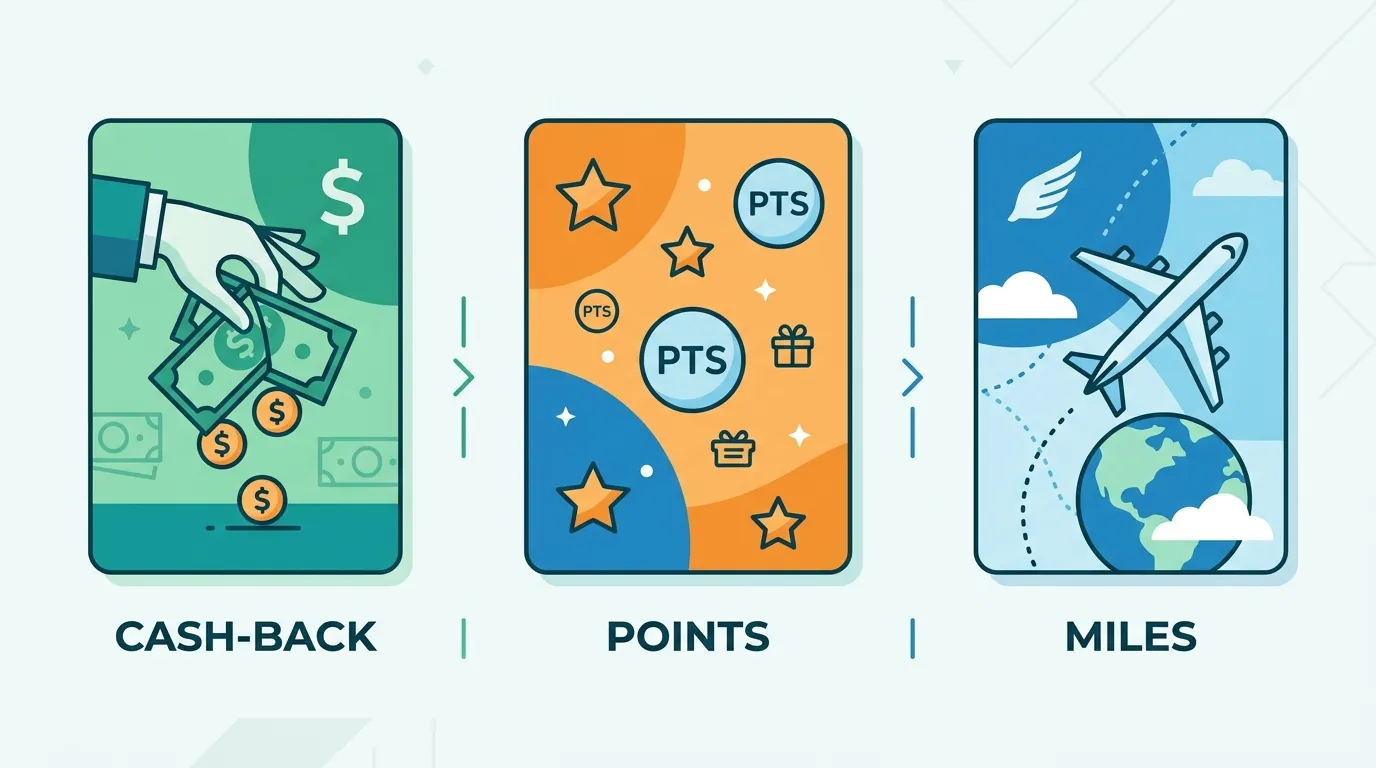
The Consumer Financial Protection Bureau (CFPB) identifies three primary reward currencies: cash back, points, and miles. Each has different earning and redemption mechanics, while many cards also add benefits such as travel credits, airport lounge access, insurance protections, or partner discounts.
Understanding those differences can make it easier to compare a rewards card with your actual spending patterns, annual fees, redemption preferences, and ability to pay the balance in full.
Cash-Back Credit Cards
Cash-back cards are generally the simplest rewards structure to understand. The card returns a percentage of eligible spending as a monetary reward, which may be provided as a statement credit, direct deposit, check, or another permitted redemption option.
For example, a card offering 2% cash back would generally produce $2 in rewards for every $100 in eligible purchases. A consumer spending $2,000 per month on purchases eligible for that rate would generate $40 in rewards for that month, before considering any exclusions, spending caps, or category rules.
Some cards offer a single rate on most purchases, while others use different rates for categories such as groceries, dining, gas, entertainment, or travel.
Cash back can be particularly straightforward because the reward has a defined dollar value. There is usually less need to calculate the potential value of points or compare different redemption options.
However, cash-back cards can still have restrictions. Certain purchases may be excluded, bonus categories may change, and elevated earning rates can sometimes apply only up to a specified spending limit.
Points-Based Rewards
Points programs introduce more flexibility but also more complexity.
A points card may award a certain number of points per dollar spent, with additional points available for selected categories. Those points can potentially be redeemed for cash back, travel, gift cards, merchandise, or other options depending on the issuer.
The value of points can vary depending on how they are redeemed. The CFPB notes that points may be used in several ways and that their value can differ between redemption options.
For example, 50,000 points could have one value when redeemed for cash and a different effective value when used through a travel program or transferred to a partner.
This makes points cards more difficult to evaluate using the advertised earning rate alone. A card offering 3 points per dollar is not necessarily providing more value than a card offering 2% cash back. The underlying question is what each point is actually worth when redeemed.
Chase similarly notes that the value of rewards can vary depending on the redemption method.
Airline Miles and Travel Rewards
Miles-based cards are commonly associated with airlines, although modern travel rewards programs can be more complicated than simply earning miles for flights.
Co-branded airline cards generally earn miles that are deposited into the associated airline loyalty account. Those miles may then be used for award flights, upgrades, or other services according to the airline's program rules.
Travel-oriented cards can also provide benefits beyond the miles themselves. Depending on the card, these may include:
- Airport lounge access
- Free checked bags
- Priority boarding
- Travel credits
- Hotel benefits
- Rental-car coverage
- Trip cancellation or interruption protections
- Foreign transaction fee benefits
These additional features can represent meaningful value for someone who travels frequently. For someone who rarely travels, however, paying an annual fee for travel-specific benefits may produce less practical value.
Sign-Up Bonuses Can Change the First-Year Value
Rewards cards frequently use introductory offers to attract new customers. A sign-up offer may provide cash back, points, or miles after the cardholder reaches a specified spending requirement during an introductory period.
The CFPB reported that nearly one in ten dollars earned through credit card rewards was connected to sign-up bonuses in its 2024 analysis.
Because of this, the first-year economics of a card can look substantially different from its ongoing rewards rate.
Consider a hypothetical card that offers a $500 introductory reward after $3,000 in qualifying purchases within a specified period. That $500 incentive may represent more value during the first year than the card's regular rewards on everyday spending.
But the spending requirement matters. A bonus is not necessarily valuable if earning it requires spending money that would not otherwise have been spent.
Consumers should also check the exact qualification period, eligible purchases, exclusions, and any language concerning account status before assuming they will receive an introductory reward.
Annual Fees Matter
Rewards should never be considered separately from the cost of holding the card.
Some cash-back cards have no annual fee, while travel and premium rewards cards can charge substantial annual fees in exchange for additional benefits.
A simple way to evaluate the economics is:
Net annual rewards value = rewards earned + usable benefits − annual fee
Suppose a card generates $600 in annual rewards and provides $300 in benefits that the cardholder would otherwise purchase. If the annual fee is $395, the theoretical net value would be $505.
But the important word is “usable.”
A $200 travel credit does not necessarily represent $200 of real value if the cardholder would never have made the qualifying purchase. Similarly, lounge access has limited practical value for someone who rarely visits airports.
Rewards Rates Need to Match Spending Patterns
A card's earning structure should be evaluated against actual spending rather than an advertised headline rate.
Someone spending heavily on groceries may benefit from a card that provides an elevated grocery rewards rate. Someone who travels regularly may place greater value on travel spending bonuses and airline or hotel benefits.
Another consumer may prefer a flat-rate cash-back card because it does not require tracking multiple categories.
For example, consider a consumer spending $30,000 per year on eligible purchases.
At 2% cash back, the annual rewards would be:
$30,000 × 0.02 = $600
A different card might provide 3 points per dollar on certain purchases, but the effective dollar value would depend on how those points are redeemed.
This is why comparing reward currencies requires looking beyond the number printed in the marketing material.
The Importance of Redemption Rules
Earning rewards is only half of the equation. Redemption determines how much those rewards are ultimately worth.
Before applying for a card, consumers can review:
- Minimum redemption amounts
- Available redemption methods
- Point or mile transfer options
- Transfer ratios
- Travel booking requirements
- Expiration policies
- Restrictions on specific purchases
- Whether rewards can be redeemed for cash
- Rules governing account closure
The CFPB has documented consumer complaints involving unexpected promotional conditions, redemption problems, reward devaluation, and revocation of previously earned rewards.
These issues make the terms and conditions an important part of evaluating a rewards program.
Rewards Can Change Over Time
A rewards program that looks attractive when a card is opened may not remain identical indefinitely.
Issuers and loyalty-program partners can change earning structures, redemption requirements, eligible categories, or other program features. The CFPB has specifically highlighted concerns surrounding the devaluation of previously earned rewards and changes to program conditions.
This is particularly relevant for consumers who accumulate large balances of points or miles over long periods.
Keeping a huge rewards balance can create exposure to future changes in redemption value. Some consumers therefore prefer to redeem rewards periodically rather than treating points or miles as a long-term asset.
Interest Charges Can Eliminate Rewards
Rewards only provide meaningful financial value when the cost of earning them does not outweigh the benefit.
For example, earning $300 in annual rewards does not necessarily represent a gain if carrying a revolving balance results in substantially more interest charges.
The CFPB has specifically warned that consumers who carry revolving balances may pay considerably more in interest and fees than they receive through rewards.
This makes the card's APR, fees, and repayment terms just as important as its rewards program.
A consumer who regularly carries a balance may find that a lower-interest card has more practical financial value than a rewards card with a more elaborate incentive structure.
When a Single Rewards Card May Not Be Enough
Some consumers use more than one rewards card to match different spending categories.
For example, one card might be used for everyday purchases with a flat cash-back rate, while another provides elevated rewards for travel or dining.
This approach can increase rewards earnings, but it also introduces additional complexity. Managing several cards means tracking payment due dates, annual fees, reward categories, spending requirements, and account terms.
Chase notes that some consumers can combine cards with different reward structures, although eligibility and issuer-specific rules vary.
The potential benefit therefore needs to be weighed against the administrative work involved.
A Practical Way to Compare Rewards Cards
Before choosing a rewards credit card, consider the following questions:
How much do you normally spend? Look at actual spending from the previous several months rather than estimating from an ideal budget.
Which categories receive the most spending? Identify whether groceries, dining, travel, gas, online purchases, or general spending make up the largest portions of your budget.
How do you want to redeem rewards? Cash back offers simplicity, while points and miles may provide additional travel or transfer options.
Will you use the card's additional benefits? Travel credits, lounge access, insurance, and partner benefits only matter when they fit your actual habits.
Is there an annual fee? Calculate whether the rewards and benefits you realistically expect to use exceed that cost.
Can you pay the balance in full? If not, compare interest costs before focusing heavily on rewards.
What happens if the program changes? Read the rewards terms to understand how redemption rules, earning categories, expiration, and account closure are handled.
Cash Back, Points, and Miles Serve Different Purposes
Cash back is generally straightforward and easy to value. Points can offer greater flexibility, particularly when multiple redemption methods or transfer partners are available. Miles can be particularly relevant to frequent travelers who can use airline or travel-program benefits.
None of these reward structures has the same value for every cardholder.
The more useful comparison is between the card's actual earning structure, annual costs, redemption options, additional benefits, and the consumer's spending and repayment habits.
Rewards should ultimately be treated as one component of a credit card's overall economics rather than the sole reason to choose a particular product. Reviewing the complete pricing and rewards terms can reveal whether the advertised incentives translate into meaningful value for the way the card will actually be used.
References
- Consumer Financial Protection Bureau — Credit Card Rewards Issue Spotlight
- Consumer Financial Protection Bureau — Credit Card Rewards Circular
- Consumer Financial Protection Bureau — Report on Consumer Frustrations With Rewards Programs
- Consumer Financial Protection Bureau — Credit Card Agreement Database
- Chase — How to Calculate and Redeem Credit Card Rewards
- American Express — Cash Back vs. Points Rewards Cards
- American Express — Miles vs. Cash Back Credit Cards