Household finances can become difficult to manage even when income is relatively stable. Money arrives in a checking account, recurring bills are paid, everyday purchases accumulate, and unexpected expenses appear throughout the month. Without a clear view of these movements, it can be difficult to understand how much money is actually available for savings or other financial goals.
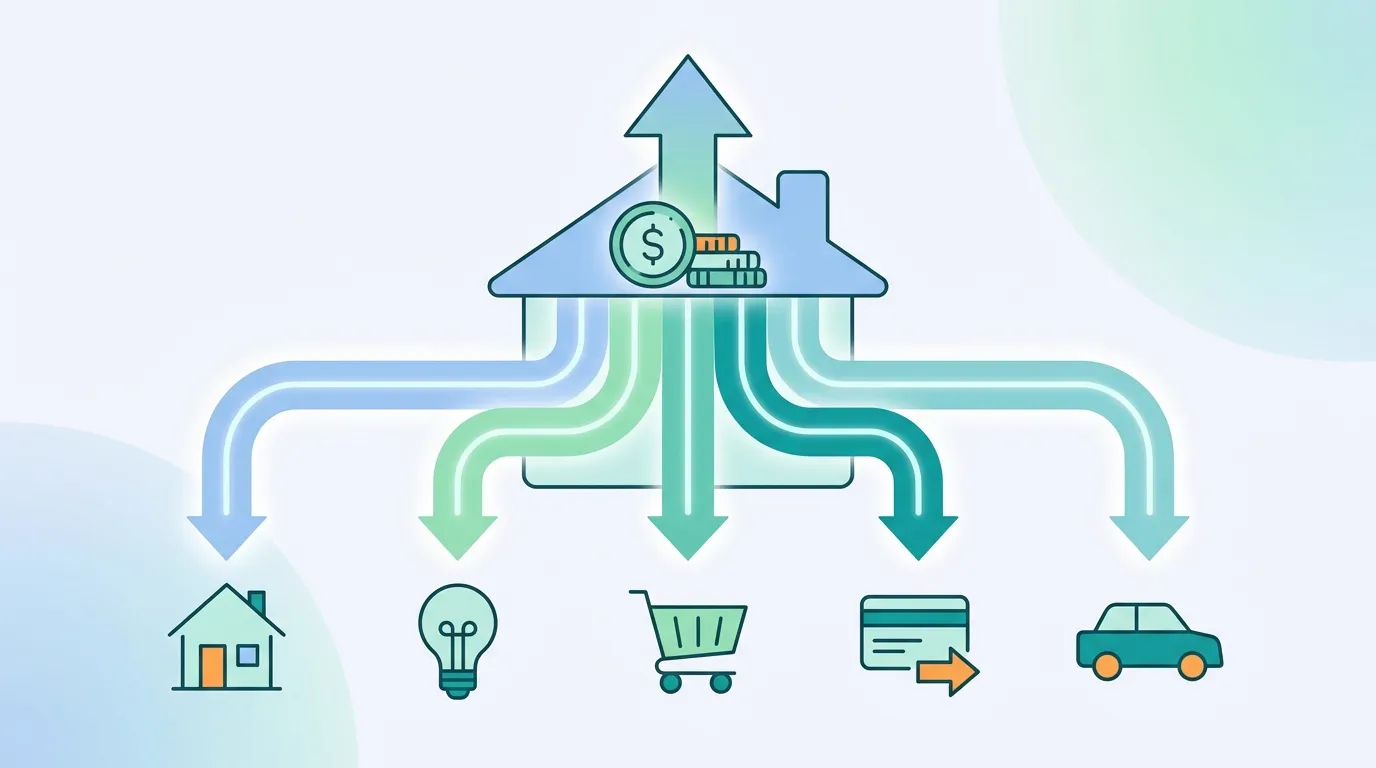
Cash flow management provides a practical framework for tracking money coming in and going out. By organizing income, recurring expenses, variable spending, debt payments, and savings, households can identify available cash and make financial decisions before the money is spent.
The goal is not to monitor every transaction indefinitely. It is to establish a system that makes recurring obligations visible and directs available cash toward savings and other priorities automatically.
Understanding Household Cash Flow
Household cash flow is the difference between money received and money spent during a specific period.
Income and Other Inflows
Common sources of household inflows include:
- Take-home employment income
- Self-employment or business income
- Freelance or contract payments
- Bonuses and commissions
- Rental income
- Interest and dividends
- Other recurring income
Cash-flow planning should generally use the amount actually available to the household after taxes and other payroll deductions rather than gross salary.
Fixed and Recurring Expenses
Some expenses are relatively predictable each month.
These may include:
- Rent or mortgage payments
- Auto loans
- Student loans
- Insurance premiums
- Utilities
- Phone and internet bills
- Subscription services
- Minimum credit card payments
Not every recurring expense is technically fixed. Utility bills, for example, can fluctuate even though the obligation occurs every month.
Variable Expenses
Variable spending changes according to household behavior or circumstances.
Examples include:
- Groceries
- Fuel
- Dining out
- Entertainment
- Clothing
- Household purchases
- Travel
- Personal spending
Separating recurring obligations from variable spending can make it easier to determine which expenses can actually be adjusted when cash flow becomes tight.
Step 1: Establish an Income Baseline
Start with realistic monthly income rather than an optimistic estimate.
Use Take-Home Income
If a salary is quoted annually, convert it into the amount that actually reaches your checking account after taxes, retirement contributions, health insurance premiums, and other payroll deductions.
For households paid weekly or biweekly, remember that the number of paychecks received in a particular month can vary.
Account for Irregular Income
Freelancers, contractors, business owners, and commission-based workers may not receive the same amount every month.
One approach is to calculate a conservative baseline using historical income and treat unusually strong months as an opportunity to increase savings, reduce debt, or build a larger cash reserve.
This can help prevent recurring expenses from being based on income that may not arrive consistently.
Step 2: Map Recurring Expenses
Recurring expenses can quietly consume a large portion of monthly cash flow because they often continue automatically.
Review several months of bank and credit card statements and identify every recurring charge.
Look specifically for:
- Streaming subscriptions
- Software subscriptions
- Gym memberships
- Insurance premiums
- Bank account fees
- Loan payments
- Credit card annual fees
- Cloud storage
- Mobile plans
- Internet services
The objective is not necessarily to eliminate recurring expenses. It is to determine which services are still useful and whether comparable alternatives offer lower costs.
Step 3: Separate Essential and Discretionary Spending
After identifying recurring expenses, divide the budget into essential and discretionary categories.
Essential expenses generally include housing, utilities, groceries, transportation, insurance, healthcare, and required debt payments.
Discretionary spending includes expenses that can potentially be reduced or postponed when necessary.
There is no universal percentage that every household should allocate to fixed costs. Housing costs, taxes, family size, location, transportation needs, and income levels can produce very different household budgets.
The more useful question is whether recurring obligations leave enough cash for emergency savings, debt repayment, and other financial priorities.
Step 4: Calculate Your Monthly Surplus
Subtract total monthly spending from net household income.
Net income − expenses = available cash flow
If the result is consistently positive, the surplus can be allocated toward goals such as:
- Emergency savings
- High-yield savings
- Retirement contributions
- Brokerage investments
- Debt repayment
- Short-term savings goals
If the result is negative, the household is spending more than it receives and needs to adjust either expenses, income, or both.
Step 5: Build a Checking Account Buffer
A checking account buffer can help manage the timing difference between paychecks and bills.
The appropriate amount varies by household. Someone with predictable biweekly income and evenly distributed bills may need a smaller buffer than someone with irregular income or several large payments concentrated around the same date.
The objective is to maintain enough cash to cover scheduled obligations without keeping unnecessarily large amounts of idle money in a low-interest checking account.
Excess cash that is not needed for near-term expenses may be transferred to an appropriate savings account, provided it remains accessible when required.
Step 6: Automate Your Cash Flow
Automation can turn a budget into an operating system.
Direct Deposit
Where available, direct deposit can route employment income into the primary checking account.
Some employers also allow employees to divide a paycheck between multiple accounts, making it possible to direct part of the income toward savings automatically.
Automatic Savings
Schedule recurring transfers from checking into savings shortly after payday.
These transfers can fund:
- Emergency savings
- High-yield savings
- Home down-payment savings
- Annual insurance expenses
- Vehicle replacement
- Home repairs
- Other short-term goals
The exact amount should be based on actual cash flow rather than an arbitrary percentage.
Bill Autopay
Automatic bill payments can reduce the risk of missing recurring due dates.
Credit card payments, loan payments, utilities, insurance premiums, and other recurring bills can often be placed on autopay.
However, accounts should still be monitored to ensure sufficient funds are available and to identify unexpected changes in billing amounts.
Step 7: Manage Credit Card Cash Flow
Credit card payments deserve particular attention because a household can appear to have available cash while simultaneously accumulating expensive revolving debt.
Track both current spending and outstanding balances.
Paying the statement balance in full when possible can help avoid interest charges on purchases under applicable card terms. If a balance is already being carried, review the card's APR and consider whether a lower-cost repayment strategy may be available.
Potential options can include a balance transfer or debt consolidation, although fees, promotional periods, eligibility requirements, and repayment terms should be evaluated carefully.
Step 8: Review Your Cash Flow Regularly
Cash-flow management does not require daily spreadsheet work.
A monthly review can be enough for many households, while people with irregular income may benefit from more frequent monitoring.
At each review, examine:
- Total income
- Recurring expenses
- Variable spending
- Savings contributions
- Debt payments
- Checking account balance
- Credit card balances
- Changes in subscription or insurance costs
A more detailed review every few months can identify expenses that have gradually increased.
A Practical 30-Day Cash-Flow Audit
A simple audit can provide a useful starting point.
1. Gather Your Statements
Collect checking-account, savings-account, and credit-card statements covering at least one full month. Several months can provide a more representative picture.
2. Categorize Every Transaction
Assign each transaction to a category such as housing, transportation, groceries, insurance, debt, subscriptions, entertainment, or savings.
3. Identify Recurring Charges
Look for payments that repeat monthly, quarterly, or annually.
Convert annual or irregular expenses into monthly amounts for planning purposes.
4. Calculate the Surplus
Subtract total spending from net income.
This reveals the amount potentially available for additional savings or debt repayment.
5. Automate the Result
Once the available surplus is understood, establish recurring transfers toward the highest-priority financial goals.
Turning Cash Flow Into a Financial System
Effective cash-flow management is not about eliminating every discretionary purchase. It is about knowing what your money needs to accomplish before it arrives.
A checking account can handle ordinary transactions and scheduled bills. A high-yield savings account can hold emergency reserves or short-term goals. Automatic transfers can move money toward savings and investments, while recurring bill payments can reduce missed-payment risk.
Regular reviews then keep the system aligned with changes in income, expenses, interest rates, insurance premiums, and financial goals.
When households have a clear understanding of their recurring obligations and available surplus, financial planning becomes more actionable. Instead of discovering what remains at the end of the month, they can decide in advance where each dollar should go.
References
- Consumer Financial Protection Bureau (CFPB): Budgeting, Managing Money, and Bank Accounts — consumerfinance.gov
- Federal Deposit Insurance Corporation (FDIC): Deposit Accounts and Personal Finance Resources — fdic.gov
- Financial Industry Regulatory Authority (FINRA): Saving, Investing, and Financial Planning Resources — finra.org