Credit card statements contain several dates and balances that can be easy to confuse. The billing cycle determines which transactions appear on a statement. The statement closing date determines when that billing period ends. The payment due date determines when at least the required minimum payment must reach the issuer. Autopay can then automate that payment, potentially reducing the risk of missed deadlines.
These details matter because payment timing can affect late fees, interest charges, promotional financing, and credit history.
For U.S. credit cards, federal rules require issuers to provide statements at least 21 days before the payment due date. A card's due date generally falls on the same calendar day each month, although the precise account terms determine how payments are processed. (consumerfinance.gov)
Understanding the relationship between billing cycles, due dates, and automatic payments can make credit card management considerably easier.
What Is a Credit Card Billing Cycle?
A billing cycle, also called a billing period, is the fixed period covered by a credit card statement.
During that period, the account can accumulate:
- Purchases
- Payments
- Credits
- Refunds
- Interest charges
- Fees
- Balance transfers
- Other eligible transactions
At the end of the billing period, the issuer generates a statement showing the account activity and the amount owed as of the end of that period. The CFPB defines the billing period as the fixed period covered by the bill sent by the card issuer. (consumerfinance.gov)
The billing cycle is therefore different from the payment period.
The cycle determines which transactions appear on a particular statement.
The due date determines when the required payment must be received.
Statement Closing Date vs. Payment Due Date
These two dates are often confused.
The statement closing date is when the billing cycle ends and the issuer calculates the statement balance.
The payment due date is when the issuer must receive at least the required minimum payment.
For example, imagine a card with:
Statement closing date: September 5 Payment due date: September 30
Purchases made during the billing period ending September 5 generally appear on the September statement.
The cardholder then has until September 30 to make the required payment.
A purchase made on September 6 would normally fall into the next billing cycle rather than the statement that closed on September 5.
This distinction can be useful when planning cash flow.
What Is the Statement Balance?
The statement balance represents the amount owed at the end of the most recently completed billing cycle.
It can include purchases and other transactions that posted during that period, minus payments, credits, and adjustments that applied before the cycle closed.
The statement will also show the minimum payment required and the payment due date.
Paying the statement balance in full by the due date can generally allow a cardholder to avoid interest on qualifying purchases when the card offers a grace period and the account meets its conditions. (consumerfinance.gov)
What Is the Current Balance?
The current balance can be different from the statement balance.
Suppose a statement closes with a $1,000 balance.
The cardholder then makes another $200 purchase after the statement closes.
The statement balance remains $1,000, while the current balance may become $1,200.
If the cardholder has a grace period and wants to avoid interest on purchases, the amount that matters is generally the statement balance under the account's applicable terms, not necessarily every transaction made after the statement closed.
The exact treatment depends on the card agreement.
What Is the Payment Due Date?
The payment due date is the date by which the issuer must receive the required payment for it to be considered on time.
The CFPB's credit card contract definitions state that the due date will appear on the bill and that it will generally be at least 21 days after the bill is sent. (consumerfinance.gov)
A payment does not necessarily count as on time simply because the consumer initiated it on the due date.
The issuer generally needs to receive the payment by the applicable deadline.
This distinction is particularly important when using mailed payments or external bill-pay services.
When Is a Credit Card Payment Considered Late?
Generally, a payment must be received by the due date and applicable cutoff time.
The CFPB states that credit card companies generally cannot treat a payment as late if it is received by 5 p.m. on the due date in the time zone specified on the statement. If the due date falls on a day when the issuer does not accept mailed payments, special rules can apply for mailed payments received on the next business day. (consumerfinance.gov)
Electronic payments can have their own cutoff times.
Because processing can vary, consumers should avoid waiting until the final hours of the due date.
What Happens if the Due Date Falls on a Weekend?
The treatment can depend on the payment method.
For mailed payments, federal rules provide specific protections when the due date falls on a day the issuer does not accept mailed payments.
Electronic or telephone payments generally must be made by the due date rather than relying on the next business day. (consumerfinance.gov)
The safest approach is to check the payment instructions on the statement and submit electronic payments early enough to account for the issuer's cutoff time.
What Is a Minimum Payment?
The minimum payment is the smallest amount the cardholder must pay by the due date to keep the account current.
It is not necessarily the amount required to pay off the balance quickly.
The statement generally displays:
- Statement balance
- Minimum payment
- Payment due date
- Applicable APRs
- Interest charges
- Fees
- Other account information
The CFPB warns that paying only the minimum can substantially extend the time required to repay a credit card balance and increase interest costs. (consumerfinance.gov)
For someone carrying a balance, paying more than the minimum can reduce the principal faster.
What Is Autopay?
Autopay is an arrangement that allows a credit card issuer to automatically withdraw a payment from a linked bank account or another authorized payment source.
Depending on the issuer, consumers may be able to choose:
- Minimum payment
- Statement balance
- Current balance
- A fixed amount
The exact options vary.
The CFPB explains that automatic payments can be convenient because they help ensure bills are paid on time. (consumerfinance.gov)
Autopay can be particularly useful for consumers who occasionally forget payment deadlines.
Autopay for the Minimum vs. Full Balance
The amount selected for autopay matters.
Minimum-payment autopay is designed primarily to prevent the account from becoming past due.
It does not necessarily prevent interest from accruing.
Statement-balance autopay can generally pay the full statement balance automatically, which may help the cardholder take advantage of a purchase grace period when applicable.
For consumers who routinely have enough money available in their bank account, automatically paying the statement balance can simplify account management.
However, consumers should understand exactly how their issuer defines each autopay option.
Autopay Does Not Eliminate the Need to Monitor the Account
Automatic payments can reduce the risk of forgetting a due date, but they are not completely hands-off.
A consumer should still review:
- The statement balance
- The payment amount
- The withdrawal date
- The linked bank account
- Available funds
- Refunds and credits
- Unexpected fees
- Unrecognized transactions
An automatic payment can only work as intended if the linked payment account has sufficient funds and the authorization remains valid.
The CFPB recommends monitoring automatic payments and understanding how recurring electronic withdrawals work. (consumerfinance.gov)
Autopay and Bank Account Balances
One potential problem with autopay is insufficient funds.
Suppose a cardholder has a $3,000 statement balance and has selected full-balance autopay.
If only $2,000 is available in the linked checking account, the payment may fail or create other banking consequences depending on the bank and issuer.
Consumers who use full-balance autopay should therefore maintain sufficient funds in the payment account.
Another option is minimum-payment autopay combined with a manual payment of the remaining balance, although this requires more active account management.
Autopay and Changing Statement Balances
Credit card balances can vary substantially from month to month.
A consumer who chooses full-statement-balance autopay may see withdrawals that change according to spending.
For example:
January statement: $600 February statement: $1,200 March statement: $750
The automatic payment can therefore vary substantially.
Consumers should make sure their checking account can accommodate those changes.
A fixed-dollar autopay amount provides more predictability but may not pay the full statement balance.
What Is a Grace Period?
A credit card grace period is the period between the end of a billing cycle and the payment due date during which qualifying purchases may avoid interest if the balance is paid in full under the card's terms.
Credit card companies are not required to provide a grace period, although most cards provide one for purchases. (consumerfinance.gov)
Grace periods generally apply to purchases rather than cash advances.
A cardholder should therefore check the agreement rather than assume every type of transaction receives the same treatment.
Paying in Full Can Preserve the Grace Period
Suppose a cardholder begins a billing cycle with no revolving balance and makes $1,500 of purchases.
The statement closes with a $1,500 balance.
If the card provides a qualifying grace period and the consumer pays the full statement balance by the due date, the consumer can generally avoid interest on those purchases.
If the consumer pays only $100, the remaining balance can generate interest according to the account's terms.
The CFPB explains that consumers can generally avoid purchase interest by paying the balance in full by the due date when the card provides a grace period. (consumerfinance.gov)
Carrying a Balance Can Affect Future Purchases
When a consumer does not pay the full balance and loses eligibility for a grace period, interest treatment can become more complicated.
The CFPB notes that consumers who carry balances may be charged interest on purchases in subsequent billing cycles, depending on the card's terms. (consumerfinance.gov)
This is one reason that understanding the relationship between the statement balance and the due date matters.
The amount paid and when it is paid can affect how interest is calculated.
Paying Early vs. Paying on the Due Date
Consumers do not generally need to wait until the due date to make a credit card payment.
Payments can often be made earlier in the billing cycle.
Paying early can have several practical benefits:
- Reducing the balance before the statement closes
- Lowering the amount reported at statement time
- Reducing the risk of missing the due date
- Making cash flow easier to manage
- Reducing interest when interest is calculated based on a daily balance
The CFPB explains that many card issuers calculate interest daily based on the average daily balance, meaning that paying sooner can reduce interest when a balance is subject to interest. (consumerfinance.gov)
Paying Before the Statement Closes
A payment made before the statement closing date can reduce the balance that appears on the next statement.
For example:
Credit limit: $10,000 Balance before payment: $4,000 Payment before statement closes: $2,000
If the payment posts before the statement closes and no additional charges offset it, the statement may show approximately $2,000 rather than $4,000.
This can matter for consumers who want to keep reported revolving balances lower.
However, payment posting times vary, so consumers should not assume a payment initiated immediately before the closing date will necessarily be reflected on that statement.
Billing Cycles Can Affect When Purchases Are Due
The timing of a purchase determines which billing cycle it enters.
Suppose a statement closes on the 10th of each month.
A purchase made on September 9 may appear on the statement closing September 10.
A purchase made on September 11 would generally fall into the next billing cycle.
That can mean the September 11 purchase has a later statement date and payment due date than the September 9 purchase.
Consumers should not interpret this as a way to avoid paying for purchases. It simply illustrates how statement timing works.
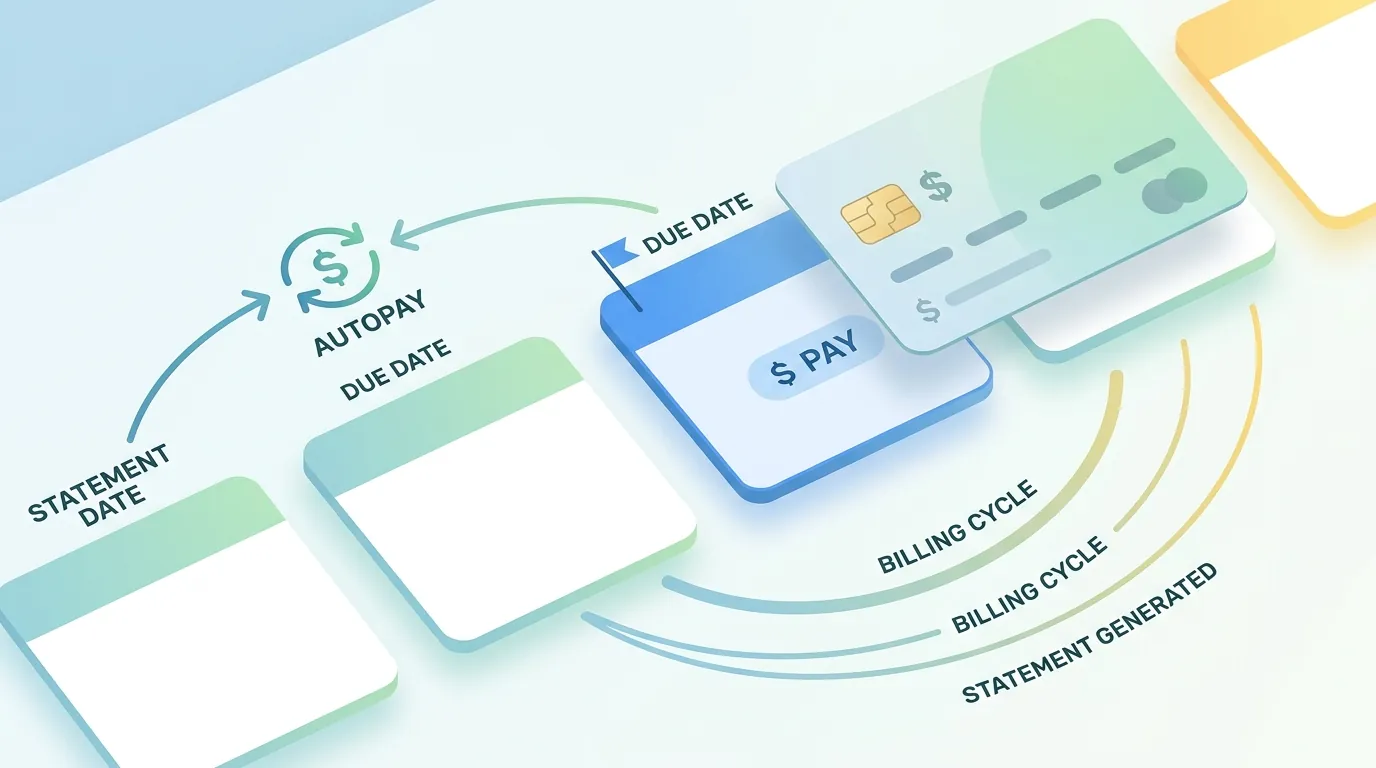
How Autopay and Billing Cycles Work Together
Autopay does not change the billing cycle.
Instead, it uses the payment information generated by the billing cycle.
The sequence generally looks like this:
1. Billing cycle ends
The issuer closes the period and prepares the statement.
2. Statement is generated
The statement shows the balance, minimum payment, due date, and other account information.
3. Autopay processes
On the scheduled payment date, the issuer withdraws the selected amount.
4. Payment posts
The payment is credited to the account.
5. New billing cycle continues
New purchases and other transactions accumulate toward the next statement.
Understanding this sequence makes it easier to determine which purchases are included in each payment.
What Happens if an Autopay Payment Fails?
An automatic payment is not guaranteed to succeed.
Possible causes include:
- Insufficient funds
- An expired payment method
- A closed bank account
- Incorrect bank information
- A canceled authorization
- Technical processing problems
If an autopay payment fails, the cardholder should check whether the minimum payment was received by the due date.
If not, contacting the issuer promptly can help determine whether the payment can be resubmitted or whether a late-fee waiver is available.
The CFPB advises consumers who have a late payment to contact the card company and ask whether the late fee can be waived. (consumerfinance.gov)
Changing or Canceling Autopay
Consumers can generally modify or cancel automatic payment arrangements through their card issuer.
However, the timing matters.
If a payment has already been scheduled for processing, canceling the authorization shortly beforehand may not prevent the transaction.
Consumers should review the issuer's instructions and allow enough time for changes to take effect.
When closing a bank account or changing banks, remember to update every recurring payment arrangement linked to the old account.
Autopay Does Not Replace Budgeting
Automatic payments can make payment timing easier, but they do not solve a spending problem.
A consumer who spends $2,000 per month on a card and automatically pays the full balance still needs $2,000 available when the payment is processed.
Likewise, minimum-payment autopay can keep an account current while allowing a balance to accumulate.
The tool manages payment execution.
It does not determine whether the underlying spending is affordable.
What to Review on Every Statement
Even consumers using autopay should review their statements each month.
Check:
Statement balance: How much was owed when the billing cycle closed?
Minimum payment: What amount must be paid to keep the account current?
Due date: When must the payment be received?
Interest charges: Was interest assessed?
Fees: Were any annual, late, cash advance, balance transfer, or other fees charged?
Transactions: Do all purchases appear legitimate?
Credits and refunds: Were expected credits posted?
Promotional balances: Are any promotional APR periods approaching expiration?
Reviewing these details can catch problems that autopay itself cannot identify.
A Practical Payment System
A simple system can combine automation with regular account reviews.
First, activate autopay for at least the required minimum payment if the issuer's terms and your cash flow make that appropriate.
Second, consider paying the full statement balance automatically if you can reliably maintain enough money in the linked account and want to avoid interest on qualifying purchases.
Third, review the statement every month.
Fourth, keep alerts enabled for payment withdrawals, large purchases, and unusual account activity when the issuer offers them.
Finally, check that the linked bank account remains active and adequately funded.
This approach separates two tasks:
Autopay handles payment timing.
The monthly statement review handles account oversight.
The Bottom Line
Credit card billing cycles determine which transactions appear on a statement, while the payment due date determines when the required payment must be received. The statement balance and current balance can differ because purchases and payments continue after the billing cycle closes.
Autopay can reduce the risk of forgetting a payment, but consumers still need to choose the payment amount carefully. Minimum-payment autopay can help keep an account current without necessarily preventing interest from accumulating. Full-statement-balance autopay can be useful for consumers who have enough money available and want to take advantage of a qualifying purchase grace period. (consumerfinance.gov)
For U.S. credit cards, statements generally must be provided at least 21 days before the due date, and payments must be received according to the issuer's applicable cutoff rules to be considered on time. (consumerfinance.gov)
The most effective system is not simply to turn on autopay and forget about the account. It is to combine automatic payments with monthly statement reviews, sufficient cash reserves, and a clear understanding of how the billing cycle, due date, and grace period interact.
References
- Consumer Financial Protection Bureau — What Is a Grace Period for a Credit Card? (consumerfinance.gov)
- Consumer Financial Protection Bureau — Credit Card Contract Definitions (consumerfinance.gov)
- Consumer Financial Protection Bureau — How Do Automatic Payments From a Bank Account Work? (consumerfinance.gov)
- Consumer Financial Protection Bureau — When Is My Credit Card Payment Considered Late? (consumerfinance.gov)
- Consumer Financial Protection Bureau — When a Payment Is Due on a Sunday or Holiday (consumerfinance.gov)
- Consumer Financial Protection Bureau — How Credit Card Interest Is Calculated (consumerfinance.gov)
- Consumer Financial Protection Bureau — Know Before You Owe: Credit Cards (consumerfinance.gov)