
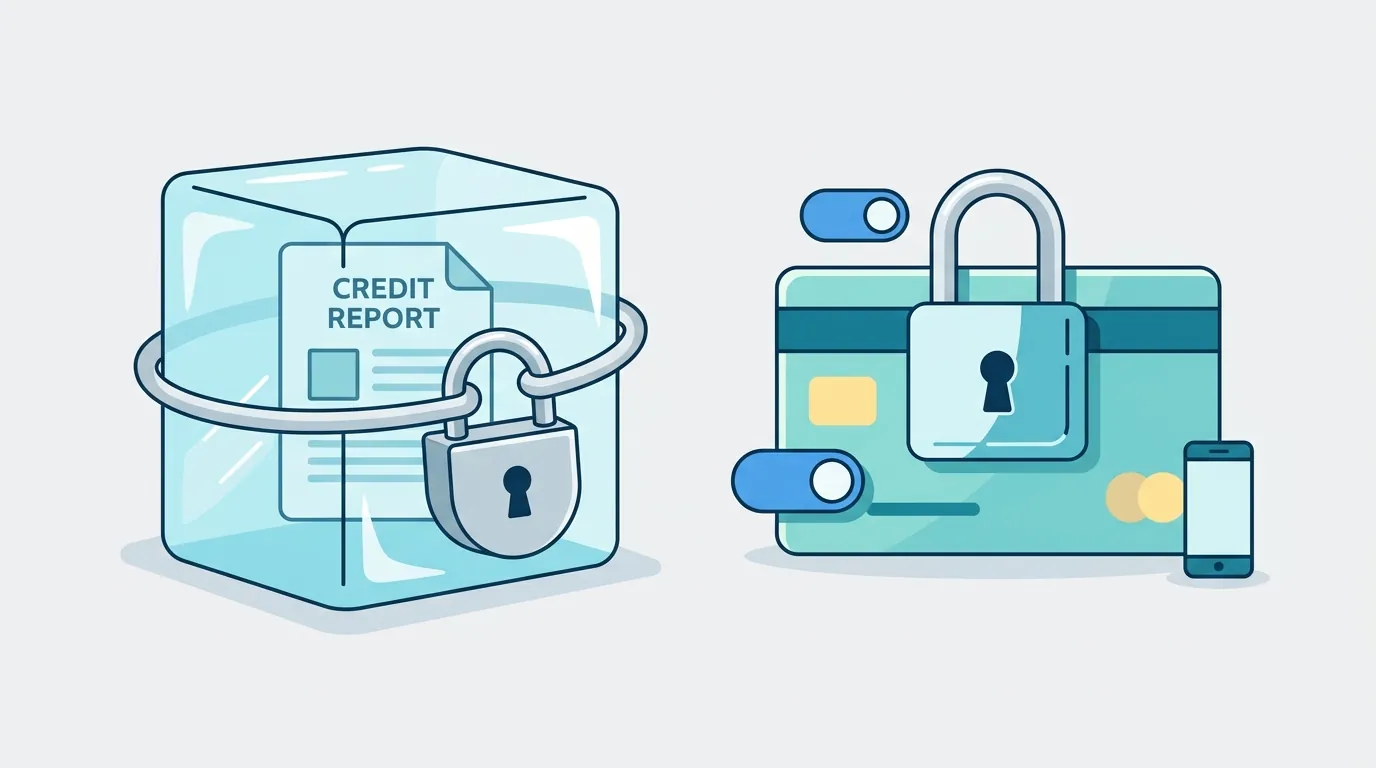
A stolen Social Security number, exposed personal information, or unfamiliar account on a credit report can create a risk that someone will attempt to open new credit in another person's name. Two tools commonly discussed for limiting that risk are credit freezes and credit locks.
Although they serve a similar purpose, they are not identical products.
A credit freeze, also called a security freeze, restricts prospective creditors from accessing a consumer's credit file. Federal law provides consumers with the right to place and lift freezes for free at the three nationwide credit reporting companies: Equifax, Experian, and TransUnion.
A credit lock is a service offered by a credit reporting company that can also restrict access to a credit report. The terms, features, and costs depend on the company and the particular service. The CFPB notes that credit locks are not more effective than security freezes and may be offered as part of paid service packages.
Understanding the differences can help consumers decide which type of protection fits their circumstances.
What Is a Credit Freeze?
A credit freeze restricts access to a consumer's credit file by prospective creditors.
When a freeze is active, a lender generally cannot access the frozen credit report for the purpose of opening a new credit account. Because creditors commonly want to review a credit report before extending credit, the restriction can make it harder for an identity thief to open a new account using stolen personal information.
A freeze does not erase a credit report.
It also does not close existing credit cards, loans, or other accounts.
Instead, it restricts certain access to the credit file.
Credit Freezes Are Free
One of the most significant characteristics of a credit freeze is its cost.
Under federal law, consumers can place and lift security freezes for free with Equifax, Experian, and TransUnion.
A consumer who wants protection across all three nationwide credit reporting companies must contact each company separately.
This is different from a fraud alert, where contacting one credit bureau generally causes that bureau to notify the other two. A freeze placed with one bureau does not automatically create freezes with the other two.
How Long Does a Credit Freeze Last?
A credit freeze generally remains in place until the consumer asks for it to be removed.
There is no requirement to renew it every year.
This makes a freeze different from an initial fraud alert, which generally lasts one year and can be renewed.
A consumer can also request a temporary lift rather than permanently removing the freeze.
For example, someone applying for a mortgage could temporarily lift the freeze during the lender's credit-review process and then reinstate it afterward.
Does a Credit Freeze Affect Your Credit Score?
A credit freeze does not affect a consumer's credit score.
The CFPB and FTC both state that placing or lifting a security freeze does not change the score.
The freeze also does not prevent a consumer from reviewing their own credit reports.
Its purpose is to control certain third-party access to the report, not to change the underlying information contained in it.
What Is a Credit Lock?
A credit lock is a service that allows a consumer to restrict or permit access to a credit report, often through an online account or mobile application.
Credit reporting companies may offer locks as standalone services or as part of broader credit monitoring or identity-protection packages.
The precise terms vary by provider.
Unlike a security freeze, a credit lock is governed by the agreement between the consumer and the credit reporting company offering the service.
That means consumers should review the service terms rather than assuming every credit lock works in exactly the same way.
Credit Lock vs. Credit Freeze
The basic distinction is straightforward.
Credit freeze:
- Protected by federal law
- Free to place and lift
- Available to consumers whether or not identity theft has occurred
- Remains until lifted
- Must generally be placed separately with all three nationwide credit reporting companies
- Can be temporarily lifted when access to the credit report is needed
Credit lock:
- Offered as a service by a credit reporting company
- Terms depend on the provider
- May be included in a paid credit-monitoring or identity-protection package
- Can generally be locked or unlocked through the provider's service
- Does not provide a greater protective effect than a security freeze simply because it is called a lock, according to the CFPB.
The practical difference is therefore less about the underlying objective and more about the legal framework, cost, terms, and management features.
Why a Credit Lock Can Seem More Convenient
Credit locks are often designed around convenience.
A consumer may be able to open an app, select a credit-report lock, and change the status quickly.
That can make the process feel easier than managing a traditional freeze through separate credit bureau accounts.
However, convenience does not necessarily mean stronger protection.
The CFPB explicitly states that credit locks are no more effective than free security freezes.
Consumers considering a lock should therefore determine whether its convenience features justify any associated cost.
A Credit Freeze May Require More Planning
The main practical issue with a freeze is remembering that lenders need access to a credit report when a consumer applies for new credit.
If someone has a freeze in place and applies for a credit card, auto loan, mortgage, or personal loan, the relevant credit bureau may need to be temporarily unlocked or the freeze lifted.
The FTC recommends identifying which credit bureau the lender will use when possible and lifting the freeze with that bureau rather than automatically removing all three freezes.
After the credit application is completed, the consumer can place the freeze back in effect.
How Quickly Can a Freeze Be Lifted?
Federal requirements establish timeframes for security-freeze requests.
The CFPB states that a nationwide credit reporting company must remove a freeze no later than one hour after receiving a request made through telephone or secure electronic means. Requests made by mail can take up to three business days.
This means a freeze does not necessarily prevent a consumer from obtaining new credit.
It simply adds a step to the application process.
Consumers who expect to apply for credit should plan ahead and make sure they can access the accounts used to manage their freezes.
A Credit Freeze Does Not Stop Existing Account Fraud
A credit freeze is designed primarily to prevent new credit accounts from being opened using the consumer's information.
It does not stop someone from using an existing credit card account.
For example, if someone steals a credit card number, a freeze does not prevent fraudulent purchases on that existing account.
The FTC specifically advises consumers to continue monitoring bank, credit card, and other financial statements even when a credit freeze is in place.
Consumers may need other security measures for existing accounts, such as issuer alerts, account passwords, card controls, and prompt fraud reporting.
A Freeze Does Not Erase Your Credit History
Another common misconception is that freezing credit removes information from a credit report.
It does not.
Accounts, balances, payment history, inquiries, and other information remain on the report.
The freeze simply restricts certain access to the file.
Consumers can still review their own credit reports while a freeze is active.
This distinction matters because a credit freeze is an access-control tool, not a credit-repair service.
A Credit Freeze Does Not Prevent Every Type of Credit Inquiry
A freeze primarily affects access by prospective creditors seeking to open new accounts.
Certain entities can still access credit files under permitted circumstances.
The CFPB notes that creditors of existing accounts and certain government entities may still be able to access a frozen file. Consumers can also access and review their own files.
The federal rules concerning freezes also have specific provisions for employment, tenant-screening, and insurance-related credit reports.
Consumers should therefore understand that "frozen" does not mean that absolutely nobody can ever access any information in the file.
Credit Freezes and Fraud Alerts Are Different
A credit freeze is also different from a fraud alert.
A freeze restricts access to the credit report.
A fraud alert does not block access. Instead, it tells businesses that check the report to take steps to verify the consumer's identity before opening new credit in that person's name.
An initial fraud alert generally lasts one year.
A consumer can place an initial fraud alert by contacting any one of the three nationwide credit reporting companies, which must then notify the other two.
In some identity-theft situations, consumers may qualify for an extended fraud alert lasting seven years.
You Can Have Both a Freeze and a Fraud Alert
These tools are not necessarily mutually exclusive.
The FTC states that consumers can place a fraud alert even when a credit freeze is already active.
They address the risk differently.
The freeze restricts access to the credit report.
The fraud alert tells businesses to take additional identity-verification steps.
For someone dealing with confirmed or suspected identity theft, using multiple protective measures can be part of a broader response.
What Happens After Identity Theft?
If someone believes their identity has already been stolen, freezing credit can be one part of the recovery process.
The FTC recommends reporting identity theft through IdentityTheft.gov, where consumers can receive a recovery plan with steps tailored to the situation.
Consumers should also examine their credit reports for unfamiliar accounts or inquiries.
Depending on what occurred, they may need to contact creditors, dispute fraudulent information, replace compromised cards, change passwords, and take additional steps.
A freeze helps limit new-account fraud but does not automatically resolve fraudulent accounts that already exist.
Credit Monitoring Is Different From a Freeze
Credit monitoring and credit freezes serve different purposes.
Monitoring services can alert consumers when certain changes appear in their credit files.
A freeze, by contrast, restricts certain access to the credit report.
The CFPB notes that consumers can use free credit-report access and security freezes as alternatives to paying for some credit-monitoring services.
Monitoring can help identify suspicious activity after it appears.
A freeze is designed to make it harder for new credit to be opened in the first place.
Consumers may choose to use either or both depending on their circumstances.
Credit Freezes Are Available Even Without Identity Theft
Consumers do not need to prove that they have been victims of identity theft to place a freeze.
The FTC states that anyone can freeze their credit for any reason.
This can make a freeze relevant even when there has been no known data breach or fraudulent account.
Someone who rarely applies for new credit may find it practical to keep the reports frozen and temporarily lift the relevant freeze when applying for a new financial product.
What to Check Before Using a Credit Lock
If a credit reporting company offers a lock as part of a paid service, review the details before signing up.
Consider:
- Whether the lock is free or requires a subscription
- What other services are included
- Whether the service automatically renews
- How to cancel the service
- How quickly the lock can be activated or removed
- What happens if the subscription ends
- Whether the service includes credit monitoring
- Whether identity-theft assistance is included
- What the agreement says about access to your credit file
The CFPB specifically notes that credit locks may be bundled with other paid services.
A consumer should understand the entire package rather than evaluating the word "lock" by itself.
Managing a Credit Freeze
If you choose to freeze your credit, keep track of the accounts used to manage each bureau.
You may need access to them when:
- Applying for a credit card
- Financing a vehicle
- Applying for a mortgage
- Refinancing a loan
- Opening another account that requires a credit check
Before submitting a credit application, determine which credit reporting company or companies the lender is likely to use.
After the lender has completed its credit review, the freeze can be reinstated.
Check Your Credit Reports Regularly
Whether or not your credit is frozen, reviewing your credit reports remains an important part of identity-theft prevention.
Look for:
- Accounts you do not recognize
- Credit inquiries you did not authorize
- Incorrect personal information
- Unexpected collection accounts
- Incorrect payment history
- Unfamiliar addresses associated with your file
The FTC recommends checking credit reports for accounts that you do not recognize as a possible sign of identity theft.
A freeze works most effectively as one part of a broader approach to protecting financial information.
Credit Freezes for Children
Credit freezes can also be relevant to children.
The FTC states that parents or guardians can request a free credit freeze for a child under 16. If the credit reporting company does not already have a credit file for the child, it can create a protected record for the purpose of freezing it.
This is intended to reduce the risk that someone will use a child's personal information to establish fraudulent credit accounts.
The process for requesting a minor's freeze differs from the process for an adult, so parents should follow the applicable instructions from each credit reporting company.
The Practical Difference Between a Freeze and a Lock
The biggest distinction is not that one blocks identity thieves while the other does not.
Both can restrict access to a credit report.
The more important differences involve legal protections, cost, provider terms, and management.
A security freeze is established under federal law and is free.
A credit lock is a service offered under an agreement with the credit reporting company.
The CFPB states that a lock is not more effective than a security freeze.
For consumers primarily looking for a no-cost method of restricting access to their credit files, a security freeze provides that option.
For consumers who value a particular provider's account-management or monitoring features, a lock may be considered as part of a broader service package.
The Bottom Line
Credit freezes and credit locks are designed to restrict access to credit reports, which can make it harder for identity thieves to open new credit accounts using stolen personal information.
A credit freeze is free, available to anyone, does not affect credit scores, and remains in place until the consumer lifts it. To freeze all three nationwide credit reports, consumers must contact Equifax, Experian, and TransUnion individually.
A credit lock is a service offered by a credit reporting company. Its terms and costs can vary, and the CFPB states that it does not provide greater effectiveness than a security freeze.
Neither tool protects against every form of fraud. Existing credit cards and bank accounts still need to be monitored, and suspected identity theft may require additional steps.
For consumers comparing the two, the relevant questions are straightforward: what protection is provided, what does it cost, how is it managed, and what happens when access to the credit report is needed?
References
- Consumer Financial Protection Bureau — What Is a Credit Freeze or Security Freeze?
- Federal Trade Commission — Credit Freezes and Fraud Alerts
- Federal Trade Commission — Understanding Your Credit
- Consumer Financial Protection Bureau — What to Do if You Are a Victim of Identity Theft
- Consumer Financial Protection Bureau — Credit Monitoring Services
- Federal Trade Commission — Identity Theft