
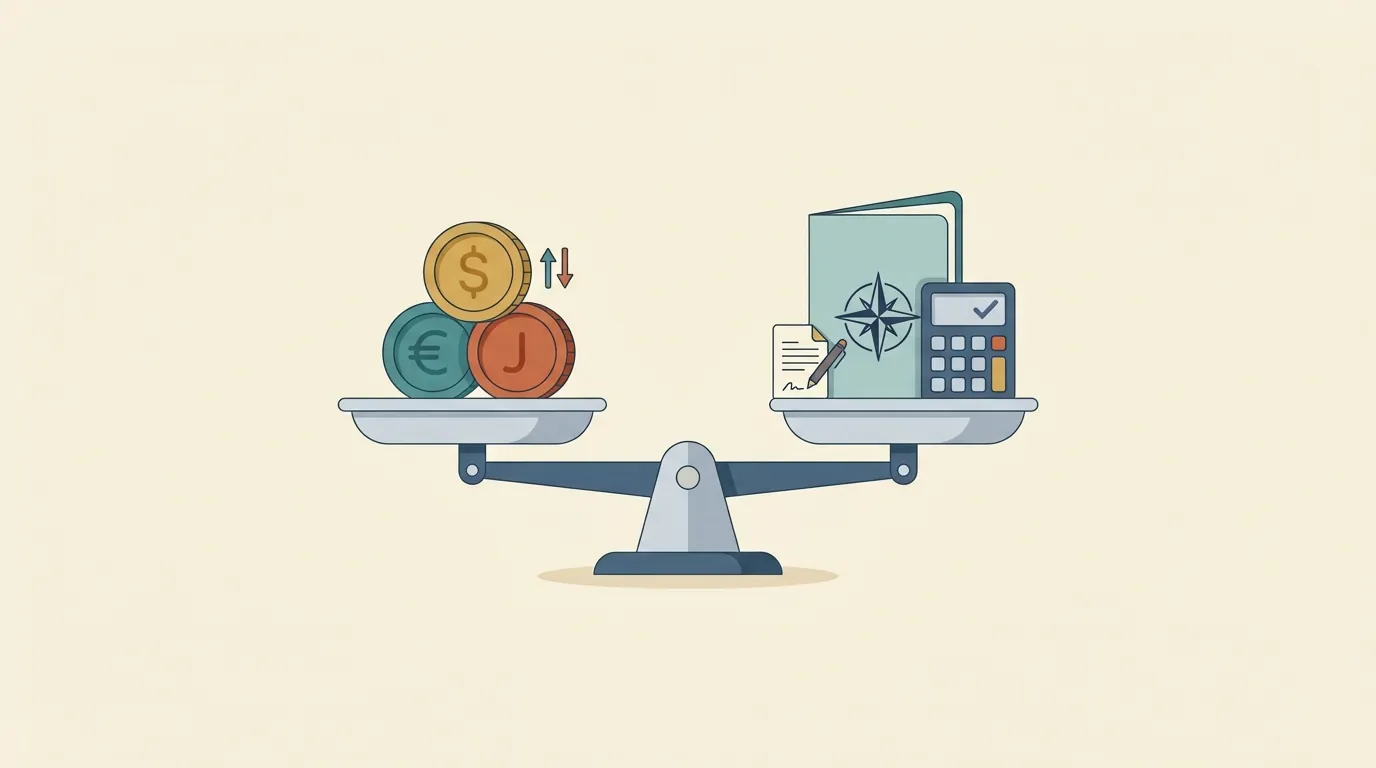
Living abroad can create new opportunities for work, business, travel, and lifestyle flexibility. It can also make personal finances considerably more complicated.
Once income, bank accounts, investments, and expenses cross international borders, domestic financial assumptions may no longer apply. Tax residency, reporting requirements, exchange rates, foreign banking regulations, and international transfer costs can all affect how much money a household ultimately keeps and how easily it can access it.
For U.S. citizens and certain U.S. residents living abroad, the financial picture can be particularly complex because U.S. tax and reporting obligations can continue even when the individual lives outside the country.
A structured expat financial plan should therefore address international tax planning, foreign bank accounts, FBAR reporting, FATCA, currency risk, international money transfers, and multi-currency banking.
Understanding U.S. Tax Obligations Abroad
Tax rules for people living internationally depend heavily on citizenship, residency, domicile, and the laws of each country involved.
Many countries primarily use residency-based taxation, while the United States generally taxes U.S. citizens and resident aliens on worldwide income.
This means a U.S. citizen living permanently in another country can generally remain subject to U.S. federal income-tax filing requirements even while also having tax obligations in the country where they live.
The U.S. tax return may need to include income such as:
- Employment income
- Self-employment income
- Interest
- Dividends
- Capital gains
- Rental income
- Certain foreign investment income
Foreign tax obligations can exist separately under the laws of the host country.
Foreign Earned Income Exclusion
The Foreign Earned Income Exclusion (FEIE) can allow qualifying taxpayers to exclude a certain amount of foreign earned income from U.S. federal income tax.
The exclusion amount is adjusted periodically for inflation.
Eligibility generally requires meeting either the physical presence test or the bona fide residence test.
Physical Presence Test
The physical presence test generally requires the taxpayer to be physically present in a foreign country or countries for at least 330 full days during a consecutive 12-month period.
The test is based on actual physical presence rather than simply holding a foreign residence.
Travel records are therefore particularly important for people who frequently move between countries.
Bona Fide Residence Test
The bona fide residence test involves establishing bona fide residence in a foreign country or countries for an uninterrupted period that includes an entire tax year, subject to the applicable rules.
The two tests are not interchangeable, and meeting one does not necessarily mean the taxpayer meets the other.
The FEIE applies to qualifying earned income and does not generally exclude every type of foreign income.
Foreign Tax Credits
The Foreign Tax Credit (FTC) can provide relief when qualifying foreign income taxes are paid on income that is also subject to U.S. taxation.
Unlike the FEIE, the foreign tax credit is generally a credit against qualifying U.S. tax rather than an exclusion from taxable income.
The amount available depends on the foreign taxes paid or accrued, the type of income, and applicable limitations.
A foreign tax credit does not automatically eliminate every U.S. tax obligation. Certain taxes may not qualify, and unused credits can be subject to carryback or carryforward rules under applicable circumstances.
For people earning income in multiple countries, comparing the FEIE and foreign tax credit requires considering the individual's entire tax situation.
Tax Treaties and Cross-Border Taxation
The United States has tax treaties with numerous countries.
Tax treaties can address issues such as residency, employment income, pensions, investment income, and relief from certain forms of double taxation.
However, treaties do not necessarily eliminate a person's tax obligations in one country simply because they are a tax resident of another.
The interaction between domestic tax law and treaty provisions can be complicated, particularly for individuals with investments, businesses, retirement accounts, or property in multiple jurisdictions.
Foreign Bank Accounts and FBAR
Opening a local bank account is often necessary for everyday expenses abroad. A U.S. person, however, may have additional reporting obligations when holding foreign financial accounts.
FBAR Requirements
The Report of Foreign Bank and Financial Accounts (FBAR), FinCEN Form 114, generally applies to U.S. persons with a financial interest in or signature authority over qualifying foreign financial accounts.
An FBAR filing is generally required when the aggregate maximum value of qualifying foreign financial accounts exceeds $10,000 at any time during the calendar year.
The $10,000 threshold applies to the combined value of qualifying accounts rather than each account individually.
For example, someone with several foreign accounts could exceed the reporting threshold even if no single account contains more than $10,000.
The FBAR is filed electronically through the Financial Crimes Enforcement Network rather than as part of the federal income-tax return.
FATCA and Form 8938
FATCA, the Foreign Account Tax Compliance Act, creates additional reporting requirements for certain U.S. taxpayers holding specified foreign financial assets.
Form 8938 is filed with the federal income-tax return when the applicable thresholds are met.
For certain unmarried taxpayers or married taxpayers filing separately who live abroad, the reporting thresholds generally begin when specified foreign financial assets exceed $200,000 on the last day of the tax year or $300,000 at any time during the year.
For qualifying married taxpayers filing jointly who live abroad, the thresholds are generally higher.
FATCA and FBAR are separate reporting regimes. Meeting one filing requirement does not necessarily eliminate the other.
Currency Risk and Expat Cash Flow
Currency exposure can affect both income and spending.
Suppose a worker earns income in one currency but has a mortgage or investment obligations denominated in another. Changes in exchange rates can increase or decrease the local-currency cost of those obligations.
This creates a currency mismatch.
Common sources of currency exposure include:
- Foreign salaries
- U.S. or foreign mortgages
- International investment accounts
- Retirement savings
- Tuition payments
- Business expenses
- Family support payments
- Cross-border taxes
The longer the time horizon and the larger the currency mismatch, the more important exchange-rate movements can become.
Multi-Currency Banking
A multi-currency account can allow eligible customers to hold balances in more than one currency.
For an expatriate, this may make it easier to receive income, pay international expenses, and convert money when needed.
However, consumers should compare the actual exchange rate and total transaction cost rather than assuming a digital provider automatically offers the lowest-cost currency conversion.
Review:
- Exchange-rate markup
- Transfer fees
- Receiving fees
- ATM fees
- Conversion limits
- Supported currencies
- Account maintenance fees
- Deposit protection
- Geographic availability
A low advertised transfer fee can still result in a relatively expensive transaction if the provider applies a significant exchange-rate spread.
International Money Transfers
Expats frequently move money between countries for rent, family expenses, investment contributions, taxes, or mortgage payments.
Before making recurring transfers, compare providers based on the total amount received, not simply the advertised transfer fee.
For example, a service charging no explicit transfer fee may still earn revenue through its exchange-rate spread.
For larger transfers, consumers should also verify transfer limits, identity requirements, settlement times, cancellation policies, and recipient-bank charges.
Currency Hedging
Businesses and sophisticated investors sometimes use financial instruments to hedge currency exposure.
Individuals with predictable cross-border obligations may encounter products such as forward contracts or other foreign-exchange arrangements.
These instruments can introduce their own costs, contractual commitments, and risks.
For most households, maintaining a currency reserve that matches near-term expenses may be simpler than attempting to actively trade exchange rates.
A hedge should therefore be evaluated based on the specific liability being protected rather than as a way to speculate on currency movements.
How to Organize Expat Finances
A structured approach can simplify cross-border financial management.
1. Determine Your Tax Residency
Identify the tax-residency rules that apply in your home and host countries.
Do not assume that moving abroad automatically ends tax obligations in your former country.
2. Map Your Worldwide Accounts
Create a record of:
- Bank accounts
- Brokerage accounts
- Retirement accounts
- Foreign pensions
- Business interests
- Real estate
- Insurance policies
For U.S. persons, track foreign account maximum balances carefully when determining potential FBAR and FATCA reporting requirements.
3. Separate Currency Needs
Determine which expenses are denominated in each currency.
Maintain enough readily accessible funds in the currency needed for recurring obligations while avoiding unnecessarily large idle balances where practical.
4. Compare International Banking Costs
Evaluate exchange-rate spreads, transfer fees, ATM charges, account fees, and deposit protections before choosing a bank or multi-currency provider.
5. Review Investment and Retirement Accounts
Some U.S. financial institutions restrict or change services for customers who move overseas. Foreign investment products can also create complicated U.S. tax consequences for U.S. persons.
Review the rules before opening foreign investment accounts rather than assuming that a locally available product receives the same tax treatment as a U.S. investment account.
6. Work With a Cross-Border Tax Professional
International tax compliance can involve multiple reporting systems, foreign tax credits, treaties, residency rules, and investment-specific provisions.
A tax professional with experience in both jurisdictions can help identify filing obligations and avoid relying on assumptions based solely on domestic tax software.
The Bottom Line
Expat personal finance requires more than simply opening a local checking account after moving abroad.
For U.S. citizens and other taxpayers subject to U.S. international reporting rules, worldwide income, foreign bank accounts, and foreign financial assets can create additional filing requirements. The FEIE, foreign tax credit, tax treaties, FBAR, and FATCA each address different aspects of cross-border taxation and reporting.
Currency management is equally important. Matching income and expenses by currency, comparing international transfer costs, and understanding exchange-rate exposure can reduce unnecessary financial friction.
Before relocating or establishing long-term financial ties abroad, create a clear map of your tax residency, accounts, investments, currencies, and recurring obligations. For complex situations, professional cross-border tax advice can be valuable because a seemingly simple financial decision in one country can have consequences in another.
References
- Internal Revenue Service (IRS) — U.S. tax rules for citizens and residents abroad, foreign earned income, foreign tax credits, and Form 8938.
- Financial Crimes Enforcement Network (FinCEN) — FBAR filing requirements and foreign financial account reporting.
- U.S. Department of the Treasury — International tax treaties and cross-border financial policy.
- Consumer Financial Protection Bureau (CFPB) — Consumer resources concerning international money transfers and financial services.