
Buying a home is one of the largest financial commitments many households will make, and the mortgage chosen at the beginning can affect monthly cash flow, total interest costs, upfront expenses, and financial flexibility for years.
Home financing is not a single product. Buyers can encounter conventional mortgages, FHA loans, VA-backed financing, USDA loans, adjustable-rate mortgages, and specialized programs offered through lenders or housing agencies. Each has different eligibility requirements, down-payment structures, mortgage insurance rules, interest-rate features, and closing costs.
The right financing structure depends on the buyer's finances and the property rather than simply the size of the mortgage.
Start With the Loan, Not Just the Home Price
A home priced at $400,000 does not necessarily require a $400,000 mortgage.
The amount borrowed depends on the purchase price, down payment, financing program, and any eligible costs included in the transaction.
But the loan amount is only one part of affordability.
A buyer also needs to account for:
- Principal and interest
- Property taxes
- Homeowners insurance
- Mortgage insurance, when applicable
- Homeowners association dues
- Maintenance and repairs
- Closing costs
- Cash reserves after closing
The Consumer Financial Protection Bureau notes that mortgage terms, loan type, and loan term can affect both monthly payments and the total interest paid over the life of the loan. (Consumer Financial Protection Bureau)
This is why qualifying for a particular loan amount does not necessarily mean that borrowing that amount is comfortable for the household budget.
Conventional Mortgages
Conventional mortgages are loans that are not part of a government-backed mortgage program.
They represent a large share of the U.S. mortgage market and can be available with different down-payment amounts, terms, and pricing structures depending on the lender and borrower's qualifications.
The CFPB notes that conventional loans typically cost less than FHA loans but can be harder for some borrowers to qualify for. (Consumer Financial Protection Bureau)
Conventional financing can therefore appeal to borrowers with established credit, stable income, sufficient assets, and a down payment that fits the lender's requirements.
A borrower putting less than 20% down may generally be required to carry private mortgage insurance under many conventional loan structures. The specific cancellation and termination rules depend on the loan and applicable requirements.
FHA Loans
Federal Housing Administration loans are government-insured mortgages designed in part to make home financing accessible to borrowers who may not qualify as easily for conventional financing.
The CFPB identifies FHA loans as a government-backed option that can offer a low down payment and may be available to borrowers with lower credit scores. (Consumer Financial Protection Bureau)
That accessibility can come with additional costs, including FHA mortgage insurance.
For a prospective buyer, the relevant comparison is not simply the minimum down payment. The buyer should consider the complete cost of financing, including the interest rate, upfront and ongoing mortgage insurance, closing costs, and expected time in the home.
A smaller initial cash requirement can be useful, but it does not automatically produce a lower-cost mortgage over the entire borrowing period.
VA-Backed Home Loans
Eligible veterans, active-duty service members, and certain surviving spouses may qualify for VA-backed home financing.
VA-backed purchase loans can allow eligible borrowers to purchase a home without a down payment in qualifying circumstances, and VA states that the program does not require private mortgage insurance. Borrowers still need to satisfy VA and lender requirements concerning credit, income, occupancy, and other factors. (Veterans Affairs)
A VA-backed loan is obtained through a participating private lender, with the VA guaranteeing a portion of the loan.
Borrowers may also have to pay a VA funding fee unless they qualify for an applicable exemption. Other closing costs and lender charges can still apply. (Veterans Affairs)
For eligible buyers, comparing the total financing cost—including the funding fee and lender charges—is more informative than focusing solely on the down-payment requirement.
USDA and Other Government-Backed Financing
USDA home loan programs can provide another financing route for qualifying buyers in eligible rural areas.
The CFPB identifies USDA loans as government-backed financing intended for qualifying borrowers in rural areas, including certain low- to middle-income households. (Consumer Financial Protection Bureau)
Eligibility depends on the specific program, property location, household income, and other requirements.
State and local housing agencies may also provide programs for first-time buyers, lower- and moderate-income households, public-service employees, or buyers in targeted communities. (Consumer Financial Protection Bureau)
These programs can change the upfront cash requirement or provide other forms of assistance, but buyers should review the complete terms rather than assuming assistance means the mortgage itself has a lower total cost.
Fixed-Rate Mortgages Provide Payment Predictability
A fixed-rate mortgage keeps its interest rate unchanged throughout the loan term, assuming the borrower does not refinance or otherwise modify the loan.
The most familiar structures include 30-year and 15-year mortgages.
A longer term generally produces a lower required principal-and-interest payment than a shorter term for the same loan amount and interest rate, but it can result in substantially more interest paid over the life of the loan.
A shorter mortgage term generally requires a larger monthly payment while reducing the number of years over which interest accrues.
The CFPB specifically notes that the loan term affects monthly principal-and-interest payments, interest rates, and total interest paid. (Consumer Financial Protection Bureau)
For buyers comparing terms, monthly affordability and lifetime borrowing costs should be considered together.
Adjustable-Rate Mortgages
Adjustable-rate mortgages, or ARMs, work differently.
The interest rate can remain fixed for an initial period before adjusting according to the terms of the mortgage.
An ARM may have an initial rate that differs from the rate available on a comparable fixed-rate mortgage. After the initial period, however, the payment can change when the interest rate adjusts.
Buyers evaluating an ARM should understand:
- Initial fixed-rate period
- Index used for future adjustments
- Margin
- Initial adjustment cap
- Subsequent adjustment caps
- Lifetime interest-rate cap
- Potential maximum payment
- Timing of the first adjustment
An ARM can be particularly important to evaluate based on how long the buyer expects to own the property.
A buyer planning to move before the first adjustment faces a different interest-rate exposure from someone expecting to keep the mortgage for several decades.
The Down Payment Is Only Part of the Upfront Cost
A common mistake is to calculate the cash required for a home purchase using only the down payment.
Closing can involve a range of other expenses, including lender charges, appraisal costs, title-related expenses, prepaid interest, property taxes, insurance premiums, and escrow funding.
Some transactions also involve seller concessions or lender credits that affect how certain costs are handled.
The actual amount required at closing depends on the transaction and loan structure.
That makes it important to review the lender's disclosures carefully instead of relying on a rough percentage of the purchase price.
Mortgage Rates and APR Are Different
The interest rate determines the cost of borrowing the mortgage principal, but it does not necessarily capture every borrowing cost.
The annual percentage rate, or APR, incorporates the interest rate and certain finance charges into a broader annualized measure.
That makes APR useful when comparing mortgage offers, although it should not be treated as a universal replacement for reviewing the complete loan estimate.
Two mortgages can have similar interest rates but different fees.
Conversely, one loan can have a slightly lower rate but substantially higher upfront costs.
The length of time the borrower expects to keep the mortgage can therefore influence which pricing structure makes financial sense.
Preapproval Helps Define the Financing Range
Mortgage preapproval is an important step before serious home shopping.
A lender typically reviews information such as income, assets, debts, credit history, and other financial documentation to determine whether the borrower appears eligible for financing under the lender's standards.
Preapproval is not the same thing as final loan approval.
The property itself still needs to satisfy applicable requirements, and the lender may require an appraisal, title work, additional documentation, and other underwriting steps.
A preapproval can nevertheless give buyers a clearer idea of the loan amount they may be able to obtain and the conditions attached to that financing.
Compare Loan Estimates, Not Just Advertised Rates
Mortgage advertisements can emphasize an attractive interest rate while leaving other costs less prominent.
When comparing lenders, buyers should review the actual loan terms and estimated costs.
Important items include:
Interest rate: What rate is being offered, and is it fixed or adjustable?
APR: What does the broader borrowing-cost measure show?
Points: Is the borrower paying upfront to obtain a lower interest rate?
Lender fees: What origination and processing charges apply?
Mortgage insurance: Is it required, and how is it calculated?
Cash to close: How much money will actually be required at closing?
Prepayment terms: Are there any applicable restrictions or penalties?
Rate lock: How long is the quoted rate protected, and what happens if closing is delayed?
Comparing these elements provides a more complete picture than comparing interest rates alone.
Credit and Debt Affect Mortgage Pricing
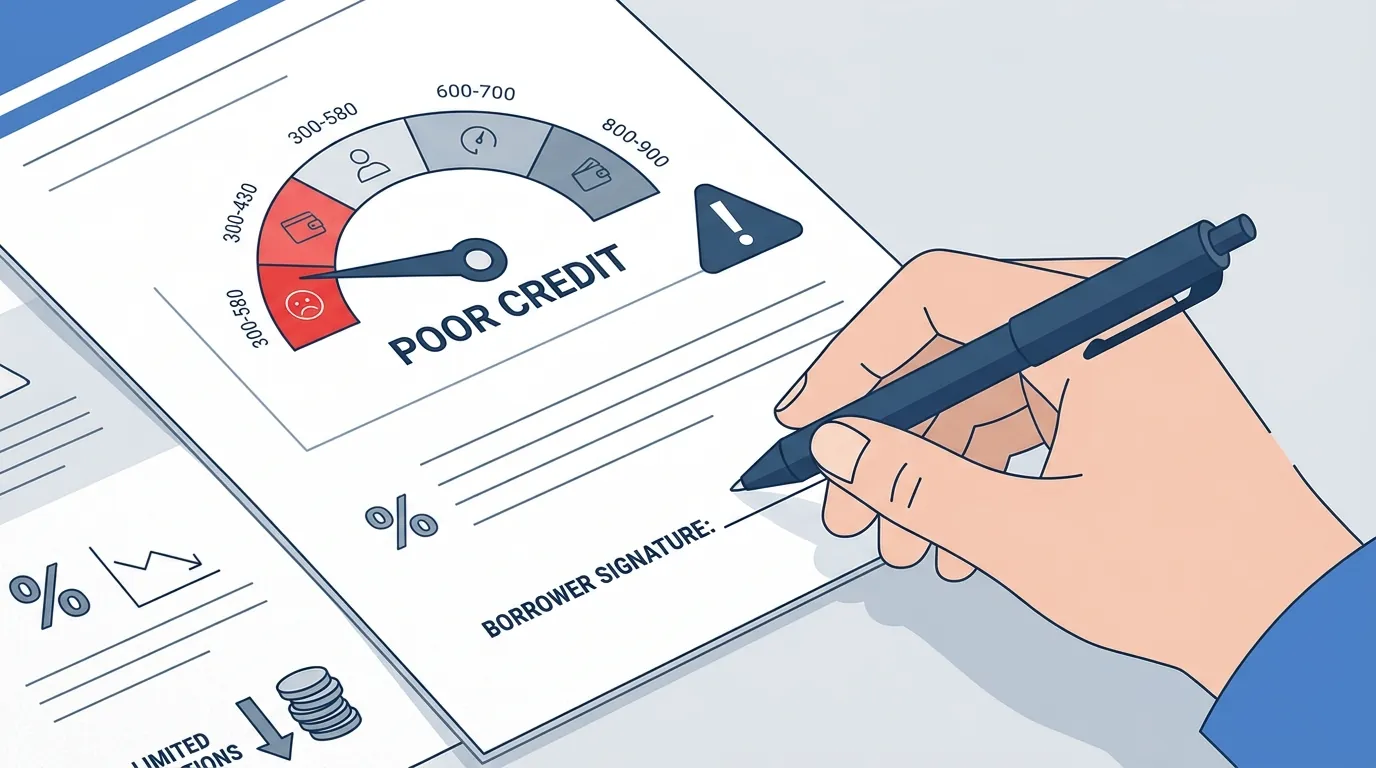
A borrower's credit profile can influence both eligibility and mortgage pricing.
Lenders also evaluate income, existing debts, assets, employment history, and other factors when assessing whether a borrower can support the proposed mortgage.
A buyer with a strong credit profile may have access to different pricing from someone with significant credit problems.
That does not mean a lower credit score makes homeownership impossible. Government-backed programs and other lending structures may serve borrowers with different financial profiles.
However, buyers should understand that the interest rate is only one component of borrowing cost. A higher rate can materially increase the total amount paid over a long mortgage term.
Choosing a Mortgage Around the Buyer's Timeline
A mortgage should be considered alongside the expected period of homeownership.
Someone expecting to remain in a property for decades may place significant weight on long-term rate stability and total interest costs.
A buyer who expects to relocate in several years may evaluate upfront points, closing costs, and adjustable-rate structures differently.
This does not mean borrowers should attempt to predict future mortgage rates or assume they will definitely refinance later.
Refinancing involves new closing costs, qualification requirements, market conditions, and uncertainty about future rates.
The original mortgage should therefore make sense on its own rather than depending on an assumed future refinance.
Don't Forget the Property Itself
Mortgage approval is not solely about the borrower.
The lender also needs information about the property being financed.
An appraisal can be required to establish an estimate of the property's market value for lending purposes. If the appraisal comes in below the purchase price, the buyer may need to renegotiate the transaction, provide additional funds, or reconsider the purchase depending on the circumstances.
Property taxes, insurance requirements, condition, location, and association obligations can also affect the overall cost of ownership.
A mortgage that appears affordable based on principal and interest alone may look very different after these expenses are included.
A Practical Mortgage Comparison
Before choosing a home loan, buyers can organize their comparison around several questions:
How much cash can comfortably be used for the purchase?
How much should remain available after closing?
Which mortgage programs does the buyer qualify for?
Is a fixed or adjustable rate appropriate for the expected ownership period?
How much will mortgage insurance cost, if applicable?
What are the lender's closing costs and other fees?
What is the APR?
How much interest will be paid under the proposed term?
How would the payment change under an adjustable-rate structure?
Does the monthly payment remain manageable if property taxes or insurance increase?
These questions shift the focus from obtaining the largest possible mortgage to understanding the actual financial commitment.
Home Financing Is a Long-Term Cost Decision
A mortgage determines much more than how a buyer pays for a house.
It affects monthly cash flow, upfront liquidity, tax and insurance expenses, exposure to changing interest rates, and the total cost of acquiring the property.
Conventional, FHA, VA, USDA, fixed-rate, and adjustable-rate mortgages each approach those trade-offs differently. Government-backed programs can expand financing access for qualifying borrowers, while conventional mortgages may provide different pricing and qualification structures. (Consumer Financial Protection Bureau)
For buyers, the most useful comparison is therefore not simply the advertised interest rate or required down payment. The full financing picture matters: loan amount, term, APR, mortgage insurance, closing costs, cash reserves, payment stability, and expected ownership period.
A well-structured mortgage should fit the buyer's broader financial position rather than simply making a particular home purchase possible.