B2B companies can generate substantial sales while still experiencing cash-flow pressure. A customer may receive an invoice with 30-, 60-, or 90-day payment terms, while the business needs cash immediately for payroll, inventory, suppliers, taxes, transportation, and other operating expenses.
This timing mismatch creates a working-capital gap.
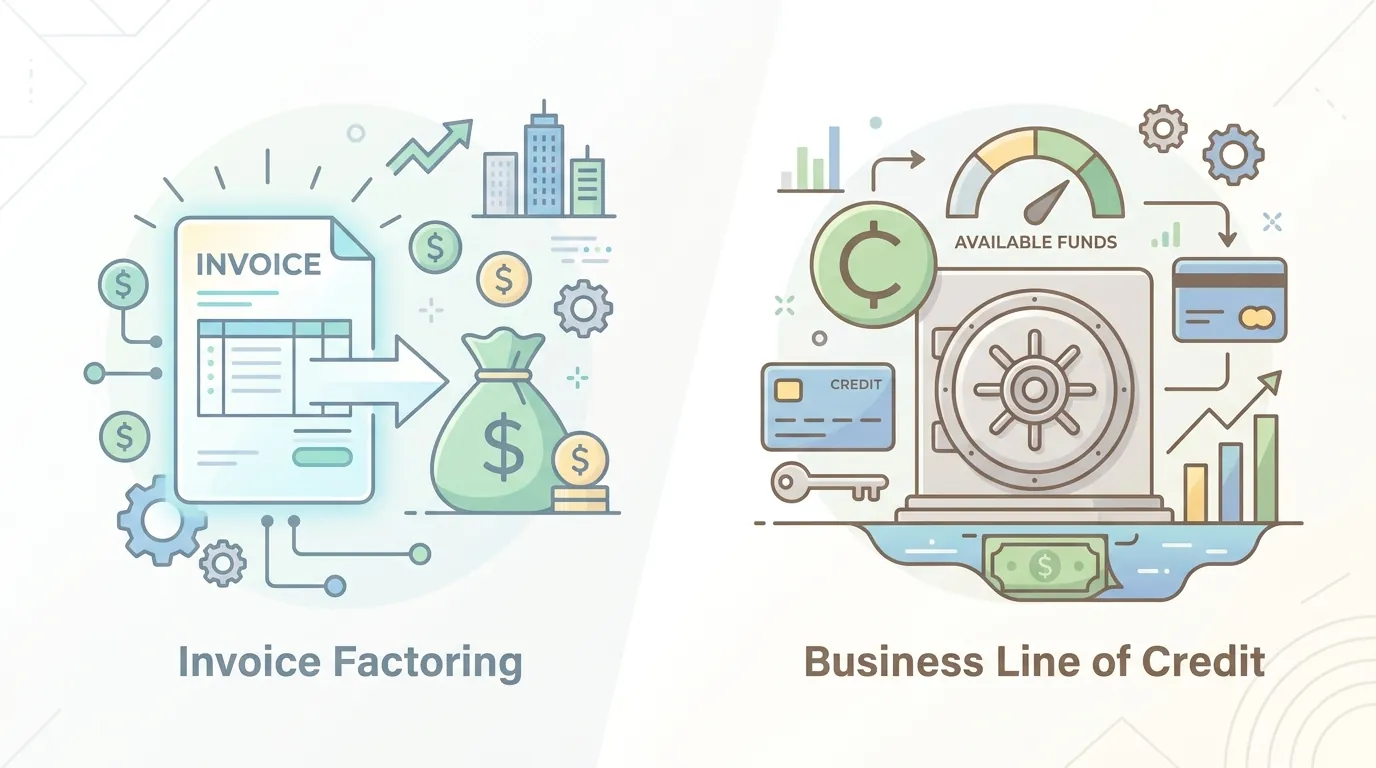
Two financing structures commonly used to address that gap are invoice factoring and business lines of credit. Both can provide access to cash before or during a customer's payment cycle, but they work differently.
Invoice factoring involves selling or assigning eligible accounts receivable to a financing company, which advances a portion of the invoice value and collects the receivable. A business line of credit instead provides a revolving borrowing facility that the company can draw and repay according to the credit agreement.
The U.S. Small Business Administration describes invoice financing as a way to obtain advances against unpaid invoices, while a revolving line of credit allows a business to access funds up to an established limit and generally pay interest on the amount drawn.
Understanding the difference is important because the financing structure can affect borrowing costs, customer relationships, collateral requirements, reporting obligations, and day-to-day cash management.
What Is Invoice Factoring?
Invoice factoring is a form of accounts receivable financing in which a business transfers eligible invoices to a factor in exchange for an advance.
A simplified transaction looks like this:
- A business sells $100,000 of products to a commercial customer.
- The business issues a $100,000 invoice with 60-day payment terms.
- The factor approves the receivable.
- The factor advances a percentage of the invoice value.
- The customer eventually pays the invoice.
- The factor releases the remaining amount after applicable fees and adjustments.
The precise legal structure can vary. In some arrangements, the factor purchases the receivable; in others, the financing is structured with recourse or other contractual protections.
The Office of the Comptroller of the Currency describes factoring as a form of receivables financing in which the factor purchases receivables and may also provide services such as credit investigation, bookkeeping, and collection.
What Is a Business Line of Credit?
A business line of credit is a revolving financing facility with an established credit limit.
If a company receives a $250,000 line of credit, it may be able to draw a portion of that amount when needed, repay it, and subsequently draw again, subject to the lender's terms and available credit.
For example:
- Credit limit: $250,000
- Initial draw: $80,000
- Remaining availability: $170,000
- Repayment: $30,000
- New availability: potentially $200,000
The company generally pays interest on the amount it actually borrows rather than on the entire unused limit, although some facilities can have commitment or unused-line fees.
The SBA describes revolving business credit as a flexible source of financing that can be used as needed up to an established limit.
Invoice Factoring vs. Business Lines of Credit
The central distinction is how the financing is supported.
| Feature | Invoice Factoring | Business Line of Credit |
|---|---|---|
| Primary basis | Eligible invoices | Business creditworthiness and/or collateral |
| Funding source | Receivables | Revolving credit facility |
| Customer payment | Often directed to factor | Normally remains with business |
| Repayment | Customer pays invoice | Business repays lender |
| Credit limit | Often tied to eligible receivables | Set by lender |
| Personal guarantee | Depends on provider | May be required |
| Customer involvement | May be visible | Usually limited |
| Availability | Can grow with eligible invoices | Limited by credit line |
| Main use | Accelerating receivable collections | Flexible working capital |
The exact structure varies among providers, particularly for recourse, notification, collateral, and repayment provisions.
How Invoice Factoring Works With B2B Invoices
Suppose a business has $500,000 in outstanding eligible invoices.
A factoring company might advance 80% of approved receivables.
The initial advance would be:
$500,000 × 80% = $400,000
The remaining $100,000 represents the reserve, from which applicable factoring fees and other adjustments may be deducted before the balance is returned.
The actual advance percentage, reserve, fees, and eligibility rules vary by factor.
Factors can also establish limits for individual customers. The OCC notes that factors may establish overall client limits as well as sublimits for individual third-party customers based on payment status, exposure, and credit strength.
That means a company cannot necessarily finance every invoice simply because it has issued the invoice.
How a Business Line of Credit Works
With a line of credit, the lender evaluates the business and establishes a borrowing limit.
Underwriting can consider:
- Business revenue
- Cash flow
- Credit history
- Time in business
- Profitability
- Existing debt
- Bank activity
- Accounts receivable
- Inventory
- Business assets
- Owner guarantees
The structure can be secured or unsecured.
A secured line may use accounts receivable, inventory, equipment, cash, or other collateral.
The SBA notes that business lines of credit can be secured by assets and are available through banks and alternative lenders.
For traditional small-business lending, cash flow remains an important repayment consideration. The OCC states that for most small-business loans, the primary source of repayment is business cash flow.
Qualification Differences
Invoice factoring can place substantial emphasis on the creditworthiness of the business's customers.
That can matter when a company itself has limited operating history or uneven financial performance but sells to established commercial customers with reliable payment histories.
A factor may evaluate:
- Customer credit quality
- Invoice aging
- Payment history
- Customer concentration
- Disputed invoices
- Returns
- Contract terms
- Industry risk
A conventional business line of credit may place more emphasis on the borrowing company's own financial condition.
The SBA notes that banks commonly request business financial statements, bank-account information, and tax returns when evaluating business credit lines.
Neither structure is automatically easier to obtain. The underwriting simply emphasizes different sources of repayment and risk.
Cost Differences
The cost structure is another major distinction.
A business line of credit generally uses an interest rate applied to outstanding balances, although additional fees may apply.
Invoice factoring commonly uses a factoring fee or discount structure rather than a conventional loan interest rate.
A factoring agreement may also contain:
- Origination or setup fees
- Wire fees
- Minimum-volume requirements
- Collection fees
- Reserve requirements
- Early-termination fees
- Recourse charges
Because the pricing models differ, businesses should calculate the actual dollar cost of obtaining working capital rather than comparing a factoring fee directly with a line-of-credit interest rate.
For example, receiving $80,000 today against a $100,000 invoice does not necessarily mean the financing cost is $20,000. Part of the $20,000 may be a reserve that is eventually returned after the customer pays.
The contract determines how the economics actually work.
Recourse vs. Non-Recourse Factoring
One important factoring distinction is recourse.
With recourse factoring, the business may remain responsible if a customer fails to pay because of credit-related or contractual problems specified in the agreement.
Non-recourse factoring can shift certain customer-credit risks to the factor, but the protection is not necessarily absolute.
Fraud, commercial disputes, product returns, service disagreements, and other exclusions can remain the seller's responsibility depending on the contract.
Businesses should therefore read the recourse provisions carefully rather than assuming "non-recourse" means every unpaid invoice becomes the factor's loss.
Customer Relationships and Confidentiality
Factoring can affect how customers experience the company's billing process.
Depending on the arrangement, customers may be instructed to make payments directly to the factor.
That can be useful from a collections and administrative perspective, but it also makes the financing relationship visible.
Some businesses may prefer to maintain direct control over customer billing and collections.
The SBA distinguishes invoice financing from factoring partly on this basis: with invoice financing, the customer can continue directing payment to the business, while factoring can involve the factor receiving invoice payments.
For companies with long-standing B2B relationships, this operational difference can be important.
Borrowing Capacity
Factoring capacity generally moves with the amount and quality of eligible receivables.
If a business generates more qualifying invoices, financing capacity may increase.
If customers pay down their invoices, the receivables disappear and the financing balance is reduced accordingly.
A line of credit operates differently.
If the lender approves a $500,000 facility, the business may have access to that committed amount subject to the agreement even when receivables fluctuate.
However, a lender can reduce, suspend, or terminate availability if contractual conditions are breached or the company's financial condition changes.
Some asset-based lines of credit also use borrowing-base formulas, meaning their availability can fluctuate with eligible receivables and inventory.
ABL Lines and Invoice Factoring
The distinction becomes less clear when a business uses an asset-based line of credit.
Asset-based lending can use accounts receivable and inventory as collateral, with borrowing capacity calculated using advance rates and eligibility requirements.
The OCC identifies accounts receivable and inventory financing as a form of collateral-based commercial lending used to provide working capital.
For example, an ABL facility might establish:
- 85% advance rate on eligible receivables
- 50% advance rate on eligible inventory
- Specific customer concentration limits
- Reserves for certain risks
- Periodic borrowing-base reporting
This can provide significant revolving liquidity while allowing the business to retain ownership of its receivables.
SBA Working Capital Financing
Businesses should also be aware that certain SBA programs can provide revolving working-capital financing.
The SBA 7(a) Working Capital Pilot (WCP) is designed to provide monitored lines of credit and can support businesses that borrow against accounts receivable or inventory. The SBA currently describes the program as offering lines of credit up to $5 million for eligible small businesses, with requirements that can include at least one year of operating history and timely financial statements and receivables/payables aging reports.
This can be relevant for companies seeking a structured line of credit rather than selling invoices to a factor.
When Factoring May Fit a Business
Invoice factoring can be relevant when:
- Customers pay slowly
- The company has substantial B2B receivables
- Sales are growing faster than available working capital
- Cash is tied up in invoices
- Traditional credit qualification is difficult
- Customer credit quality is relatively strong
- The business needs financing tied directly to receivable volume
The OCC notes that receivables financing is primarily used for working capital but can also support acquisitions, debt restructuring, and periods of financial stress.
When a Business Line of Credit May Fit
A revolving line of credit can be useful when the company needs flexible access to capital for recurring expenses.
Potential uses include:
- Payroll
- Inventory purchases
- Supplier payments
- Marketing
- Seasonal expenses
- Short-term operating gaps
- Unexpected expenses
- Growth initiatives
The major benefit is flexibility: the company can draw funds when needed rather than financing every invoice individually.
However, approval depends on the lender's underwriting criteria, and the business must manage repayments and borrowing capacity carefully.
A Practical Cash-Flow Example
Imagine a B2B distributor generating $300,000 in monthly sales.
Customers generally pay after 60 days.
That means the company can have approximately $600,000 of sales sitting in accounts receivable at a given point in the cycle, although the actual balance will vary.
Suppose the company needs $150,000 to purchase inventory before customers pay outstanding invoices.
With factoring, the business could potentially monetize eligible invoices and obtain an advance.
With a line of credit, the business could draw $150,000 from its available facility and repay the balance as customer collections arrive.
The important difference is that factoring directly monetizes receivables, while the line of credit provides a separate revolving borrowing facility.
Comparing the Total Cost
Businesses should compare financing using a consistent framework.
Consider:
1. Total financing cost
Include interest, factoring fees, setup charges, monitoring fees, and other expenses.
2. Available borrowing
Determine how much capital can actually be accessed.
3. Repayment structure
Understand when and how funds must be repaid.
4. Collateral
Identify which business assets are pledged or transferred.
5. Customer involvement
Determine whether customers will interact directly with the financing provider.
6. Administrative requirements
Compare reporting, borrowing-base certificates, invoice submissions, audits, and other obligations.
7. Flexibility
Determine whether the facility can accommodate seasonal fluctuations and revenue growth.
8. Contract restrictions
Review minimum volumes, covenants, personal guarantees, termination provisions, and prepayment requirements.
Questions to Ask a Financing Provider
Before choosing either structure, a business should ask:
- How much financing can I access?
- What determines my borrowing capacity?
- Which invoices or assets are eligible?
- What fees apply?
- Is pricing based on interest, a factoring fee, or another structure?
- Are there minimum monthly volumes?
- Is a personal guarantee required?
- Is the financing recourse or non-recourse?
- Who collects customer payments?
- Will customers know that invoices are being financed?
- How quickly are funds advanced?
- What reporting is required?
- Can the facility expand as sales increase?
- What happens when a customer pays late?
- What happens if an invoice is disputed?
- Are there early-termination or unused-line fees?
These details can materially change the economics of the financing.
Managing B2B Cash Flow Over the Long Term
Invoice factoring and business lines of credit solve similar liquidity problems through different mechanisms.
Factoring converts eligible receivables into working capital and can connect financing capacity directly to customer invoices. A business line of credit instead creates a revolving pool of borrowing capacity that can be used for multiple operating needs.
For a company with strong commercial customers and a persistent gap between invoicing and collection, factoring can provide a direct way to accelerate receivable cash flow.
For a company with predictable financial performance and broader recurring funding needs, a revolving credit facility may provide more flexibility.
Asset-based lines and SBA working-capital programs can occupy an intermediate position, particularly when a business has substantial receivables or inventory and wants revolving financing rather than selling individual invoices.
The right analysis should therefore go beyond the advertised financing rate. Businesses should compare the total cost of capital, available credit, collateral requirements, customer involvement, reporting burden, repayment mechanics, and ability to scale the facility as the company grows.
For B2B businesses, the underlying problem is often not a lack of sales. It is the timing difference between making a sale and collecting the cash. Financing can bridge that gap, but the structure chosen determines how much that bridge costs and how much control the business retains over its receivables and cash flow.
References
- Office of the Comptroller of the Currency — Accounts Receivable and Inventory Financing
- Office of the Comptroller of the Currency — Accounts Receivable and Inventory Financing Handbook
- U.S. Small Business Administration — 3 Ways to Get Working Capital for Your Business
- U.S. Small Business Administration — 7(a) Working Capital Pilot
- U.S. Small Business Administration — Business Lines of Credit