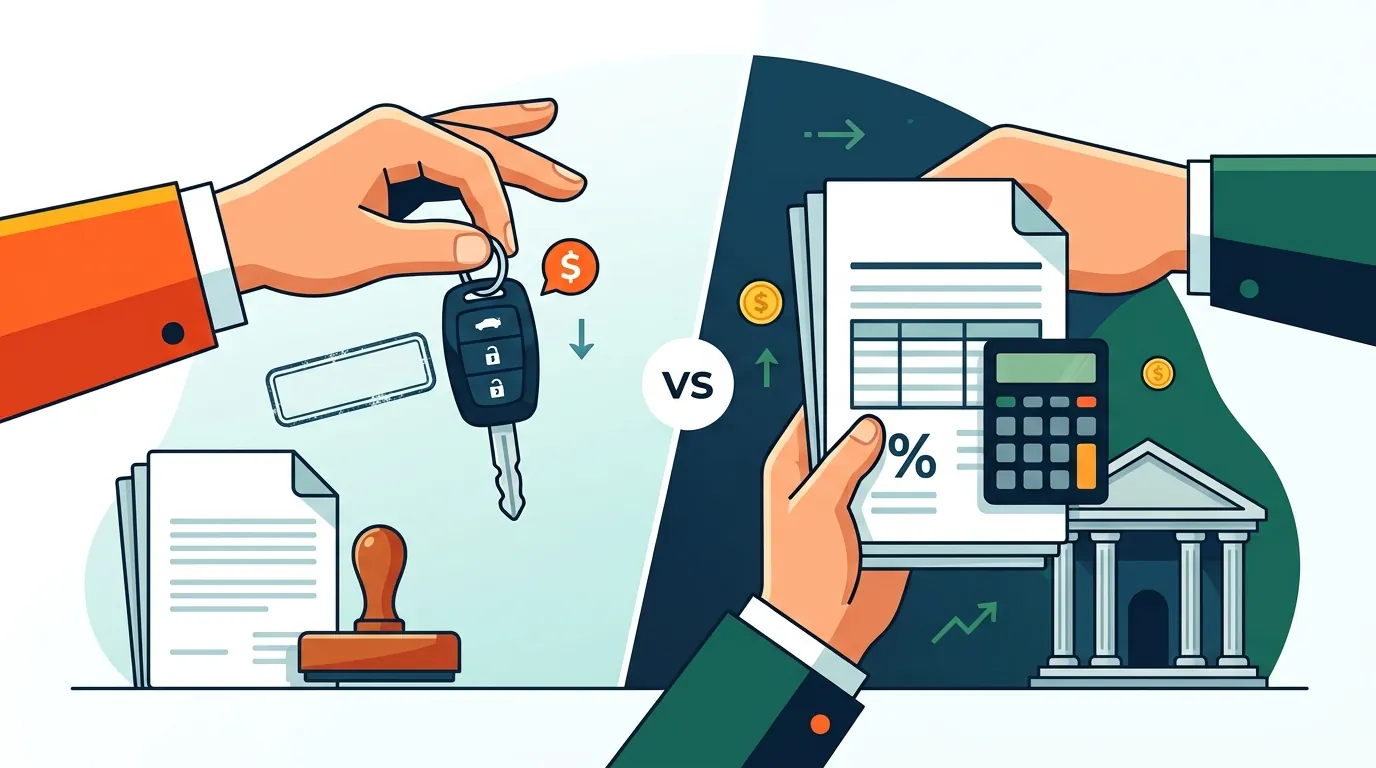
Buying a vehicle involves two separate financial decisions: choosing the vehicle and deciding how to pay for it.
For buyers who need financing, the loan can come directly from a bank, credit union, or other financial institution, or the dealership can arrange financing as part of the purchase process. These options can lead to different interest rates, fees, negotiation dynamics, and repayment costs.
Dealer financing can be convenient because the financing process happens alongside the vehicle purchase. Direct financing can provide a preapproval that establishes borrowing terms before the buyer negotiates with the dealership.
Neither structure has identical terms for every borrower. Credit history, income, down payment, loan amount, vehicle type, loan term, and lender policies all influence the offer.
Understanding how each financing route works can make it easier to compare the actual cost of a vehicle loan rather than focusing only on the monthly payment.
How Dealer Financing Works
Dealer financing is often called dealer-arranged or indirect financing.
The buyer applies for financing through the dealership, which collects the necessary information and sends it to one or more potential lenders. Those lenders may include banks, credit unions, and auto finance companies.
If a lender agrees to finance the purchase, it provides the dealership with a rate commonly called the buy rate. The dealer may then present a contract to the buyer at a higher interest rate, depending on the arrangement.
The difference between the lender's buy rate and the contract rate can compensate the dealer for arranging the financing.
The eventual loan may therefore be held or serviced by a financial institution rather than by the dealership itself.
This distinction matters because "dealer financing" describes how the financing is arranged, not necessarily who ultimately owns or services the loan.
How Bank Financing Works
With direct financing, the buyer applies to a bank, credit union, or other lender independently of the dealership.
A lender may provide a prequalification or preapproval showing an estimated or approved interest rate, loan amount, and repayment period.
The buyer can then use that information while shopping for a vehicle.
For example, suppose a bank preapproves a buyer for a $30,000 auto loan at a specified APR for 60 months. The buyer knows the approximate financing parameters before entering the dealership.
The dealer can still make a financing offer. The buyer can compare that offer against the existing bank financing rather than evaluating the dealer's loan in isolation.
The CFPB specifically recommends comparing financing offers from multiple lenders before or during the vehicle-shopping process.
Dealer Financing Can Be More Convenient
One of the biggest practical differences is convenience.
A dealership can often handle several parts of the transaction at once:
- Vehicle purchase
- Financing application
- Loan documentation
- Trade-in
- Down payment
- Registration-related paperwork
- Optional vehicle products
For buyers who want a single transaction, this can simplify the process.
The dealership may also have relationships with several lenders, allowing it to submit applications to multiple financial institutions.
However, convenience does not necessarily mean the financing has the lowest total cost.
A buyer can use dealer financing for convenience while still negotiating the APR, loan term, and other terms.
Bank Financing Can Provide a Benchmark
A direct loan offer can give a buyer a concrete benchmark before negotiating with a dealer.
Suppose a buyer obtains a preapproved loan with a 7% APR.
The buyer can then ask the dealership whether it can provide financing at a lower rate or with otherwise more favorable terms.
If the dealer offers a different loan, the buyer can compare:
- APR
- Amount financed
- Loan term
- Monthly payment
- Finance charge
- Total payments
- Prepayment provisions
The FTC recommends obtaining financing information before visiting the dealership because a preapproval can help buyers negotiate the vehicle purchase and compare financing offers.
Dealer Rate Markups Matter
The interest rate presented by a dealership may not be identical to the rate the lender initially quoted to the dealer.
The CFPB explains that a lender may provide the dealer with a buy rate, while the dealer may offer the consumer a higher contract rate. The additional amount can compensate the dealer for arranging the financing.
For the buyer, even a relatively small rate difference can affect the total cost of a multi-year loan.
For example, consider a $30,000 loan with a 60-month term.
At a 7% APR, the monthly principal-and-interest payment would be approximately $594.
At 9% APR, it would be approximately $623.
That difference is roughly $29 per month and more than $1,700 over the full five-year repayment period, assuming the rate remains fixed and excluding other costs.
The actual loan terms will vary, but the example illustrates why comparing APRs matters.
Manufacturer-Sponsored Financing Is Different
Dealer financing is not necessarily synonymous with a dealer charging a higher rate.
Automakers and their affiliated finance companies sometimes offer promotional financing programs, such as specially reduced APRs on qualifying vehicles.
These offers can have eligibility requirements.
A promotional rate may be limited to:
- Specific models
- Certain model years
- Certain inventory
- Buyers meeting credit requirements
- Particular loan terms
- Specific down-payment requirements
The buyer may also have to choose between promotional financing and another incentive, such as a cash rebate.
The economics should therefore be evaluated using the entire transaction rather than assuming that a low advertised APR automatically produces the lowest total cost.
Comparing APR With Interest Rate
Two financing offers can have different interest rates and fees, making the annual percentage rate (APR) particularly useful for comparison.
The interest rate represents the rate charged on the outstanding loan balance.
APR incorporates the interest rate and certain finance charges into an annualized measure of credit cost.
The CFPB notes that consumers should review both the interest rate and APR when comparing auto loans.
A borrower should also review the dollar amount of the finance charge and total payments shown in the required disclosures.
These figures can reveal the actual financial impact of the loan more clearly than a monthly payment alone.
Monthly Payment Can Be Misleading
A lower monthly payment does not necessarily mean a cheaper auto loan.
One way to reduce a payment is to extend the loan term.
For example, financing the same vehicle over 72 months instead of 48 months can lower the monthly obligation, but the borrower may pay considerably more interest over the life of the loan.
Longer terms can also create a greater risk that the borrower owes more than the vehicle is worth during part of the loan.
The FTC specifically advises consumers to consider the total financing cost rather than focusing only on monthly payments.
Vehicle Price and Financing Should Be Negotiated Separately
A vehicle transaction can contain several moving parts:
- Vehicle price
- Trade-in value
- Down payment
- Financing
- Optional products
Combining everything into one monthly payment can make it difficult to see how much each component costs.
A buyer can request the vehicle's out-the-door price before discussing financing. The FTC recommends obtaining this figure in writing, including taxes and fees, so different offers can be compared more clearly.
Once the purchase price is established, the financing can be evaluated separately.
This approach also makes it easier to identify optional products that have been added to the amount financed.
Optional Add-Ons Can Increase the Loan
Dealership finance departments may offer products such as:
- Extended service contracts
- Guaranteed asset protection (GAP) products
- Credit insurance
- Maintenance plans
- Other protection products
Some may provide useful coverage in particular circumstances, but they increase the amount being financed if included in the loan.
The CFPB notes that optional add-ons can increase the loan amount and that consumers are not generally required to purchase them simply to obtain dealer financing.
A buyer should determine the price of each product separately and understand whether similar coverage is already available elsewhere.
Credit Scores Affect Both Options
Banks and dealership-arranged lenders generally consider factors such as:
- Credit history
- Credit scores
- Income
- Existing debts
- Loan amount
- Down payment
- Loan term
- Vehicle type
- New versus used vehicle
These factors can influence both approval and pricing.
A buyer with strong credit may qualify for promotional manufacturer financing that is unavailable to other applicants.
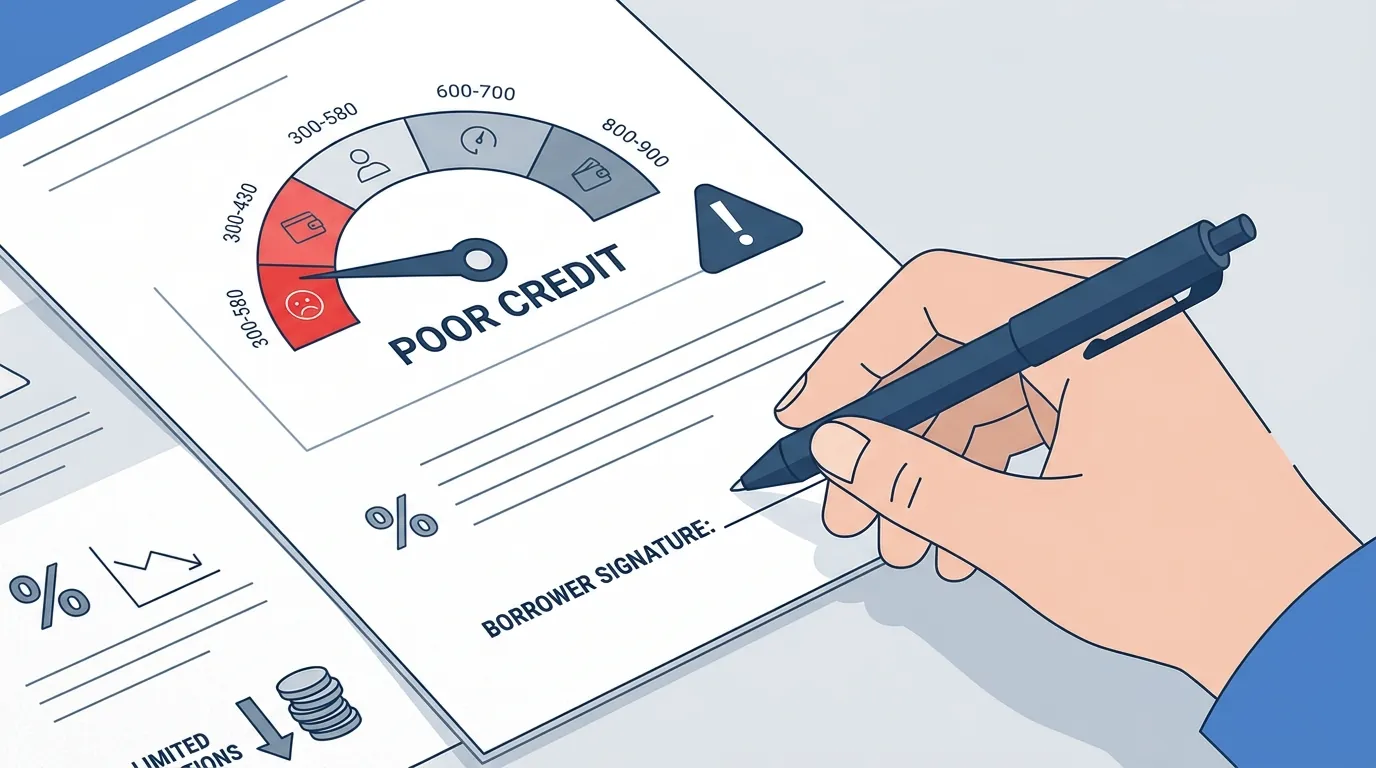
Someone with limited or damaged credit may encounter higher rates or stricter loan requirements.
This is another reason to obtain financing information before negotiating the final transaction.
What About Buy-Here, Pay-Here Financing?
A separate category is buy-here, pay-here financing.
These dealerships may finance vehicles directly rather than arranging a loan through an outside bank or finance company.
They often market financing to borrowers with limited or poor credit.
The CFPB warns that interest rates at these dealerships tend to be higher than financing available through banks, credit unions, or other lenders. It also notes that some buy-here, pay-here dealers may not report positive payment history to credit reporting companies even though they may report negative information.
Borrowers considering this type of financing should therefore examine both the total cost and how payments are reported.
Does Applying With Multiple Lenders Hurt Credit?
Auto-loan shopping can involve multiple credit inquiries.
The CFPB states that multiple inquiries made within a shopping period of approximately 14 to 45 days are generally treated as a single inquiry for scoring purposes, although the exact treatment can vary by credit-scoring model.
Consumers should still avoid unnecessary applications spread over long periods.
Getting several quotes within a concentrated shopping period can allow borrowers to compare financing without treating every inquiry as an entirely separate event under applicable scoring models.
Bank Loan vs. Dealer Financing
| Feature | Bank or Credit Union Loan | Dealer-Arranged Financing |
|---|---|---|
| Application | Directly with lender | Through dealership |
| Preapproval | Common | Usually arranged during purchase |
| Convenience | Separate financing process | Financing and vehicle purchase handled together |
| Rate source | Lender's direct offer | Lender's buy rate plus any applicable dealer markup |
| Negotiation | Rate and terms with lender | APR and terms can be negotiated with dealer |
| Manufacturer incentives | Usually unavailable through independent lender | May be available on qualifying vehicles |
| Lender choice | Buyer selects lender | Dealer may submit application to multiple lenders |
| Vehicle purchase | Financing arranged separately | Integrated with dealership transaction |
| Comparison shopping | Straightforward before purchase | Can compare against outside preapproval |
The actual terms depend on the borrower, vehicle, lender, dealership, and applicable financing program.
A Practical Comparison Example
Imagine a buyer is purchasing a $35,000 vehicle.
The buyer obtains a bank preapproval for:
- Amount financed: $30,000
- APR: 7%
- Term: 60 months
The dealership offers financing at:
- Amount financed: $30,000
- APR: 8.5%
- Term: 60 months
The dealer's offer may be convenient, but the buyer should calculate the total payments under both agreements.
The dealer could also offer a manufacturer promotional rate with a different incentive structure.
For example, one option might provide a lower APR but no cash rebate, while another provides a rebate but a higher financing rate.
The correct comparison is therefore not simply "7% versus 8.5%." The buyer should calculate the complete transaction under each scenario.
Questions to Ask the Dealer
Before signing, a buyer can ask:
Who is the actual lender?
What is the APR?
Is the APR negotiable?
Was the financing offer based on a lender's buy rate?
What is the amount financed?
What is the total finance charge?
How much will I pay over the full term?
What is the loan term?
Are there any prepayment restrictions or penalties?
Which optional products are included?
Can I remove optional products from the financing?
Is this promotional rate tied to a specific vehicle or incentive?
The answers should appear in the financing documents before the buyer signs.
A Practical Way to Compare Offers
A buyer can approach financing in a few deliberate stages.
First, determine the vehicle's out-the-door price
Separate the vehicle transaction from financing as much as possible.
Next, obtain outside financing
A bank or credit union preapproval provides a reference point for the APR, term, and maximum loan amount.
Then ask the dealer for its financing offer
The dealer may provide a competitive rate or a manufacturer-sponsored financing incentive.
Compare total costs
Review APR, amount financed, term, finance charge, total payments, and incentives.
Review the final contract
Make sure the written agreement matches the terms discussed.
This process allows the buyer to evaluate financing based on the economics of the entire loan rather than the convenience of obtaining it at the dealership.
Choosing Between Dealer and Bank Financing
Dealer financing and direct bank financing are not mutually exclusive strategies during the shopping process.
A buyer can obtain outside financing first and still ask the dealership for an offer. If the dealer provides a lower-cost financing arrangement or a qualifying manufacturer incentive, that offer can be evaluated against the existing preapproval.
The CFPB recommends comparing financing offers rather than assuming that dealer-arranged financing or direct lending will always produce a particular result.
The most important figures are the APR, amount financed, finance charge, loan term, and total payments.
A low monthly payment can hide a longer repayment period. A low advertised APR can have eligibility restrictions. A convenient dealer-arranged loan can carry a higher contract rate than the lender's original buy rate.
Taking time to separate the vehicle price from the financing terms gives buyers a clearer picture of what they are actually agreeing to pay.
References
- Consumer Financial Protection Bureau — Dealer-Arranged vs. Bank Financing
- Consumer Financial Protection Bureau — What Is a Buy Rate for an Auto Loan?
- Consumer Financial Protection Bureau — Negotiating Auto Loan Interest Rates
- Consumer Financial Protection Bureau — How Lenders Determine Auto Loan Rates
- Federal Trade Commission — Financing or Leasing a Car
- Consumer Financial Protection Bureau — Dealer F&I Departments and Optional Add-Ons