Shopping for a personal loan involves more than finding an advertised interest rate.
Before submitting a full application, borrowers may be able to prequalify and receive an estimate of the loan amount, interest rate, or monthly payment they might qualify for. This can make it easier to compare lenders without immediately committing to a loan.
Once a borrower proceeds with an actual loan, however, additional costs can become relevant. One of the most important is the origination fee, a charge imposed by some lenders for processing and funding the loan.
A personal loan with a slightly higher interest rate and no origination fee can sometimes cost less overall than a loan with a lower advertised rate but a substantial upfront charge.
Understanding how prequalification works, what origination fees pay for, and how the two affect the true cost of borrowing can help borrowers evaluate offers more accurately.
What Personal Loan Prequalification Means
Personal loan prequalification is generally an initial assessment of whether a borrower is likely to qualify for financing and, in some cases, what loan terms may be available.
The CFPB notes that lenders use the terms prequalification and preapproval differently. Some lenders rely primarily on information provided by the consumer during prequalification, while others conduct a more extensive review. Neither term necessarily represents a guaranteed final loan offer.
A prequalification may show:
- Estimated loan amount
- Estimated APR
- Estimated monthly payment
- Potential repayment term
- Possible loan purpose eligibility
The information is usually conditional.
A lender may verify income, employment, debts, credit history, and other information during the full application process. The final rate or approved amount can therefore differ from the initial estimate.
Prequalification vs. a Full Loan Application
The biggest practical distinction is that prequalification is generally designed for shopping, while a full application is part of the lender's underwriting process.
A lender may ask for basic information during prequalification and provide an estimated offer.
If the borrower decides to proceed, the lender may request additional documentation and perform a more comprehensive credit review.
Depending on the lender's process, the full application can result in a hard credit inquiry.
The CFPB explains that hard inquiries are generally associated with applications for new credit and can affect credit scores. Soft inquiries, by contrast, do not affect credit scores.
Because lender procedures differ, borrowers should ask whether a prequalification check uses a soft or hard inquiry before submitting their information.
Why Prequalification Can Help When Shopping
Prequalification can allow borrowers to compare potential financing before committing to a particular lender.
For example, someone seeking a $20,000 personal loan might receive estimated offers from several lenders.
One lender might show:
- $20,000 estimated loan
- 10.5% APR
- 48-month term
Another might show:
- $20,000 estimated loan
- 11.2% APR
- 48-month term
- No origination fee
At first glance, the lower APR may appear more attractive.
But the second offer could potentially have a lower overall cost if the first lender charges a significant origination fee.
This is why prequalification is most useful when borrowers compare the complete financing structure, not just the headline rate.
What Is a Personal Loan Origination Fee?
An origination fee is a charge that a lender may impose for processing and originating a personal loan.
The CFPB identifies origination fees as one of several possible fees associated with personal installment loans, alongside charges such as documentation fees and late fees.
The fee can be structured in different ways.
A lender might charge a percentage of the amount borrowed. For example, a 5% origination fee on a $20,000 loan would equal $1,000.
The borrower may not necessarily receive the full $20,000.
If the fee is deducted from the proceeds, the borrower could receive $19,000 while still owing according to the loan's stated principal and repayment terms, depending on the specific agreement.
That distinction is important when the borrower needs a particular amount of cash.
How Origination Fees Affect the Amount You Receive
Consider a borrower who needs exactly $15,000 to pay for an expense.
Suppose a lender charges a 4% origination fee.
The fee would equal:
$15,000 × 4% = $600
If the lender deducts the fee from the loan proceeds, the borrower could receive $14,400 rather than the full $15,000.
The borrower may therefore need to request a larger loan amount to receive the desired net proceeds.
That can increase the amount of debt and interest paid.
Alternatively, the lender may structure the fee differently, so the borrower should check the actual loan agreement rather than assuming how the charge will be handled.
Origination Fees Can Change the Cost Comparison
Imagine two lenders offer the same borrower a $20,000 personal loan for 48 months.
Lender A
- APR: 10%
- Origination fee: 5%
Lender B
- APR: 10.75%
- Origination fee: 0%
The first offer has the lower interest rate but charges a $1,000 origination fee.
The second has a higher rate but no upfront origination charge.
Depending on the repayment period and exact loan terms, the second loan could potentially have a lower overall cost.
The example illustrates why comparing interest rates alone can produce the wrong conclusion.
APR Helps Incorporate Financing Costs
The annual percentage rate, or APR, is designed to express the cost of borrowing in a standardized percentage.
The CFPB explains that APR incorporates the interest rate plus certain additional fees associated with the loan, including origination charges.
This makes APR a useful figure when comparing otherwise similar loan offers.
However, borrowers should still examine the actual dollar amounts.
A loan's APR does not tell the entire story if the borrower is comparing different loan amounts, terms, optional products, or cash proceeds.
Reviewing both the APR and the total dollar cost provides a clearer picture.
Interest Rate vs. APR
These two figures are related but not identical.
The interest rate represents the cost of borrowing expressed as a percentage of the outstanding principal.
The APR incorporates the interest rate and certain additional finance charges.
For example, a lender might advertise a personal loan at a 9.99% interest rate while the APR is higher because of an origination fee.
A borrower comparing offers should therefore avoid comparing one lender's interest rate with another lender's APR.
Compare:
APR vs. APR
and then separately examine:
Total finance charges vs. total finance charges.
Does Every Personal Loan Have an Origination Fee?
No.
Some lenders charge origination fees, while others advertise loans without them.
A lender may also vary the fee depending on factors such as credit profile, loan amount, repayment term, or other underwriting characteristics.
The absence of an origination fee does not automatically make a loan less expensive.
A lender could compensate for the absence of the fee through a higher interest rate or other charges.
The relevant question is the total borrowing cost.
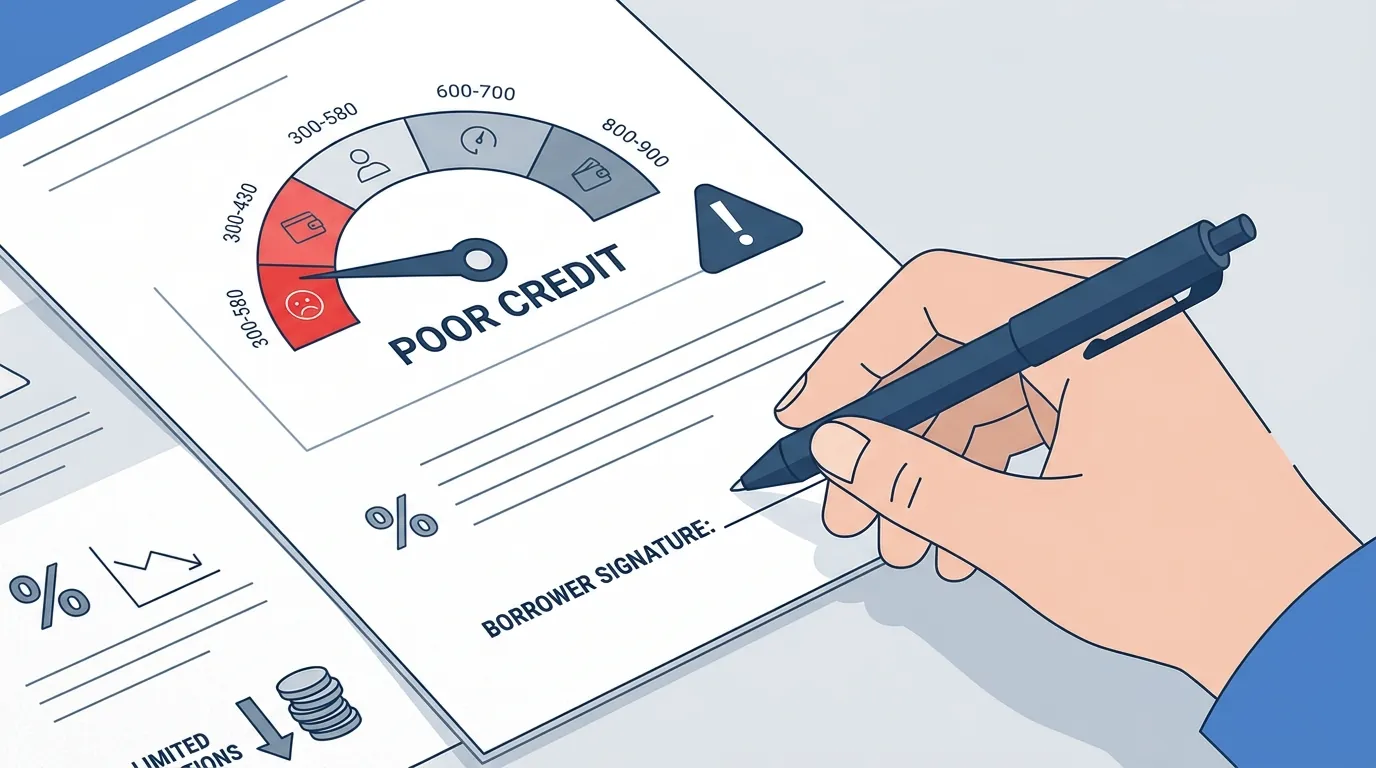
How Credit Affects Personal Loan Offers
A borrower's credit profile can influence the terms offered by a lender.
Factors considered may include:
- Credit history
- Credit score
- Income
- Existing debt
- Debt-to-income ratio
- Loan amount
- Loan term
- Employment or income stability
- Loan purpose, depending on the lender
A stronger credit profile may qualify for a lower APR, although lenders use different underwriting models.
The CFPB notes that lenders may consider factors such as income, debt, and credit history when deciding whether to offer credit and what terms to provide.
Prequalification can therefore be useful for seeing how a lender's estimated terms compare with other available offers before proceeding to a full application.
What Information Is Used During Prequalification?
The exact process varies.
A lender might request:
- Name
- Address
- Income
- Employment information
- Requested loan amount
- Desired repayment term
- Estimated credit information
- Loan purpose
Some lenders may also ask for information about existing debts.
Because prequalification is not standardized across lenders, two companies can provide estimates using different underwriting processes.
One lender's prequalification may involve a soft credit inquiry and basic information, while another may require more detailed documentation.
Borrowers should therefore read the lender's disclosure explaining what the prequalification does and does not represent.
Prequalification Is Not a Guarantee
A prequalified offer can change after the lender verifies the borrower's information.
For example, a lender might initially estimate a 10% APR based on information provided by the borrower.
During underwriting, the lender could discover:
- Lower verified income
- Higher existing debt
- Different credit information
- A different loan amount
- Documentation discrepancies
The final offer may therefore have a different rate, loan amount, or repayment term.
The CFPB specifically notes that prequalification and preapproval information is not necessarily a guaranteed loan offer.
What Happens After Prequalification?
If the borrower chooses to proceed, the lender may request documentation and conduct a full underwriting review.
The process can include verification of:
- Identity
- Income
- Employment
- Bank account information
- Credit history
- Existing debts
The lender then determines whether the borrower meets its final underwriting requirements.
If approved, the borrower receives the final loan terms and can decide whether to accept them.
This is the point at which the borrower should compare the final offer against the estimates received during prequalification.
Loan Term Can Change the Cost
Origination fees are only one part of the equation.
The repayment period can also materially affect total borrowing costs.
A $20,000 loan with a three-year term may require higher monthly payments than the same loan over five years.
The five-year loan could make the monthly payment more manageable, but the borrower may pay interest for an additional two years.
This means a lower monthly payment does not necessarily indicate a cheaper loan.
A useful comparison includes:
- APR
- Loan amount
- Origination fee
- Monthly payment
- Repayment period
- Total interest
- Total amount repaid
- Net amount received
A Loan With No Origination Fee Can Still Be Expensive
"No origination fee" can be an attractive feature, but it should not be evaluated independently.
Imagine two hypothetical offers for $25,000:
| Loan A | Loan B | |
|---|---|---|
| Interest rate | 9.5% | 10.5% |
| Origination fee | 5% | 0% |
| Term | 48 months | 48 months |
| Loan amount | $25,000 | $25,000 |
Loan A has a lower interest rate but a $1,250 origination fee.
Loan B has a higher interest rate but no origination fee.
Depending on how the fee is handled and the exact repayment structure, the difference in interest could be smaller or larger than the upfront fee.
The borrower should calculate the actual dollar cost rather than relying on the marketing language attached to either offer.
Watch for Other Personal Loan Fees
Origination charges are not the only possible fees.
The CFPB identifies several other potential personal-installment-loan charges, including documentation fees and late fees. Optional credit or disability insurance may also be offered.
Before accepting a loan, check for:
- Origination fees
- Application fees
- Documentation fees
- Late-payment fees
- Returned-payment fees
- Prepayment provisions
- Optional insurance
- Other account-management charges
Not every lender charges all of these.
The loan agreement should show which fees apply.
Prepayment and Early Repayment
Some borrowers intend to pay off a personal loan early.
If that is part of the repayment strategy, review the loan agreement for any prepayment provisions or penalties.
Early repayment can reduce future interest because interest generally accrues based on the outstanding balance and applicable loan terms.
But the financial benefit depends on the loan structure and whether any additional charges apply.
A borrower should not assume that every personal loan has identical early-repayment rules.
Comparing Multiple Prequalified Offers
Prequalification becomes particularly useful when borrowers collect comparable information from several lenders.
For each offer, record:
Estimated loan amount
Estimated APR
Interest rate
Origination fee
Estimated monthly payment
Repayment term
Estimated total repayment
Net proceeds
Then identify which figures are estimates and which are guaranteed only after final underwriting.
This prevents a borrower from comparing a preliminary offer from one lender with a final offer from another as though they were identical.
Questions to Ask Before Accepting a Loan
Before moving from prequalification to a full application, ask:
Will prequalification use a soft or hard credit inquiry?
Is the quoted APR guaranteed or estimated?
What credit information was used?
What is the origination fee?
Is the fee deducted from the loan proceeds?
How much cash will I actually receive?
What other fees apply?
What is the monthly payment?
What is the total amount I will repay?
Can I repay the loan early?
Are there any prepayment charges?
What documentation will be required for final approval?
These questions help identify differences between the initial estimate and the final financing agreement.
A Practical Prequalification Strategy
A borrower who wants a personal loan can approach the process in stages.
1. Determine the amount actually needed
Borrowing more than necessary increases the balance and potentially the interest cost.
2. Check several lenders
Prequalification can provide a preliminary basis for comparing potential rates and terms.
3. Confirm the credit inquiry type
Ask whether the process involves a soft or hard inquiry.
4. Compare APRs
APR can incorporate interest and certain loan fees, making it more useful than comparing interest rates alone.
5. Calculate the origination fee
Convert the percentage into dollars.
6. Check the net proceeds
Make sure the amount actually received is sufficient for the intended expense.
7. Compare total repayment
Consider the entire repayment period, not simply the monthly payment.
8. Review the final agreement
Make sure the final terms match the expectations created during prequalification.
The Difference Between a Quote and a Loan
Prequalification is valuable because it can provide an early indication of what financing might look like.
But it is not the same thing as receiving a completed loan.
The final lender decision may depend on verified information and a full credit review.
Likewise, an advertised origination fee or APR does not necessarily tell the borrower exactly what their individual offer will contain.
The loan agreement is the document that ultimately determines the borrower's obligations.
Understanding the Full Cost of Borrowing
Personal loan shopping often begins with an advertised interest rate, but the true cost involves several variables.
A borrower should consider the APR, origination fee, repayment term, monthly payment, total interest, total repayment, and net proceeds.
Prequalification can make this process easier by allowing potential borrowers to explore estimated terms before committing to a full application. Because lenders use the terms "prequalification" and "preapproval" differently, however, borrowers should verify what the particular lender's process actually involves.
Origination fees deserve particular attention because they can reduce the cash received or increase the effective cost of financing. The CFPB recommends reviewing the lender's disclosures and comparing offers from multiple lenders when considering personal installment loans.
Ultimately, a personal loan should be evaluated according to the amount actually needed, the cash received, the cost of borrowing, and the borrower's ability to make the scheduled payments.
A low advertised rate can be less meaningful if a large fee accompanies it, while a loan with no origination fee can still become expensive if its APR or repayment period is high.
References
- Consumer Financial Protection Bureau — Personal Installment Loan Fees
- Consumer Financial Protection Bureau — Interest Rate vs. APR
- Consumer Financial Protection Bureau — Prequalification vs. Preapproval
- Consumer Financial Protection Bureau — Credit Inquiries
- Consumer Financial Protection Bureau — When Lenders Check Your Credit