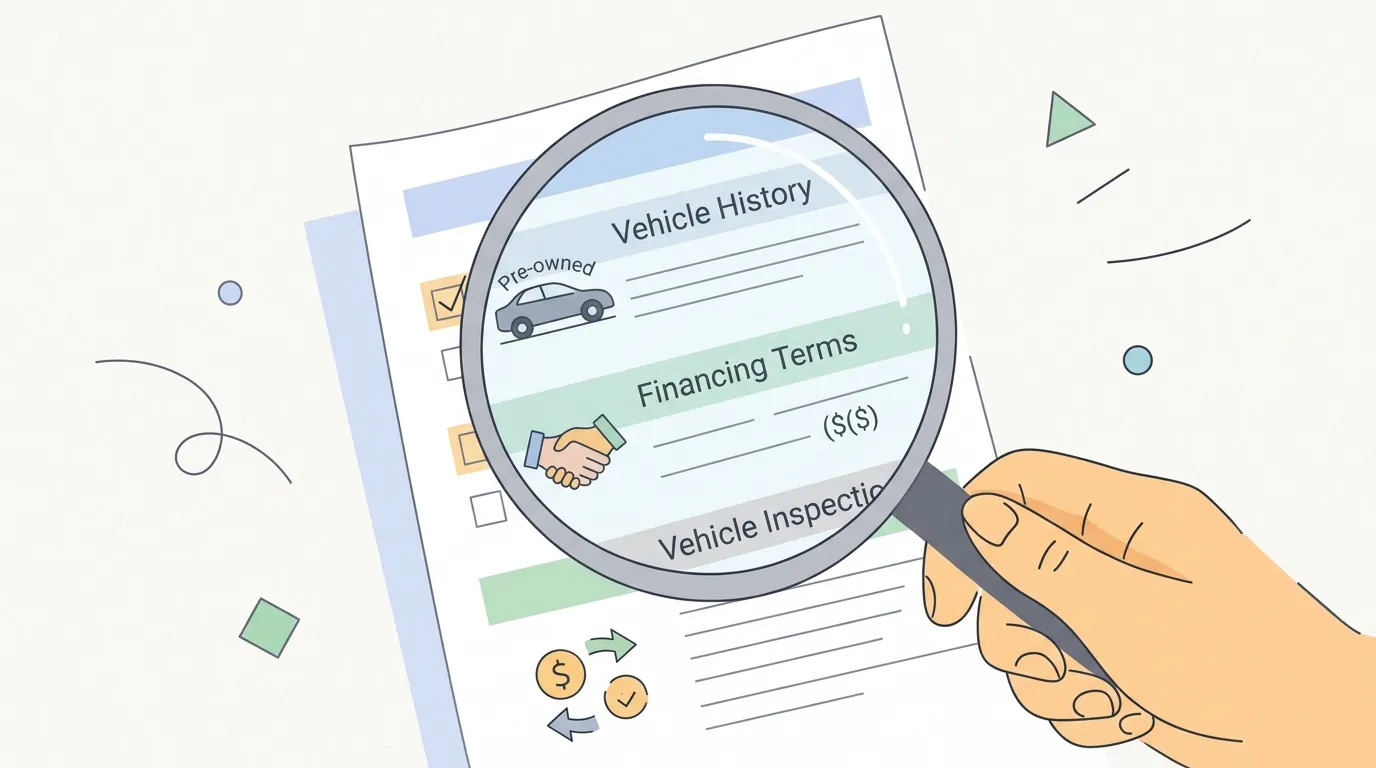
Financing a used vehicle involves more than finding a car that fits the budget and choosing a monthly payment. The vehicle's condition, age, mileage, purchase price, interest rate, loan term, fees, down payment, and financing source can all affect the total cost.
A pre-owned vehicle can have a lower purchase price than a new one, but financing can still become expensive if the loan carries a high APR or extends over a long period. Buyers may also face additional costs for repairs, maintenance, insurance, registration, taxes, and optional products added to the financing agreement.
The Federal Trade Commission recommends researching the vehicle, obtaining its history, getting an independent inspection, and comparing financing offers before completing a used-car purchase. Its guidance also emphasizes reviewing the total financing cost rather than focusing only on the monthly payment.
Understanding the vehicle and the loan separately can make the buying process easier to evaluate.
Start With the Vehicle, Not the Monthly Payment
Before discussing financing, determine whether the vehicle itself makes financial sense.
A used car's purchase price is only one part of the ownership cost. Older vehicles may require more frequent maintenance or repairs, while some models can have higher insurance or replacement-part costs.
The FTC recommends researching the model, mileage, repair history, safety information, and other ownership considerations before purchasing a used vehicle.
Buyers should consider:
- Vehicle purchase price
- Mileage
- Age
- Maintenance history
- Accident history
- Number of previous owners
- Current mechanical condition
- Insurance costs
- Expected maintenance
- Registration and taxes
A vehicle that costs less upfront can still become expensive if it requires significant repairs shortly after purchase.
Check the Vehicle History
A vehicle history report can reveal information that is difficult to identify during a brief test drive.
Depending on the report, buyers may find information about previous accidents, title status, reported mileage, ownership history, or other events.
The FTC recommends obtaining a vehicle history report before purchasing a used car. However, a history report should not replace a mechanical inspection.
A clean report does not guarantee that a vehicle is mechanically sound.
Buyers should review the report carefully and ask the seller about anything unusual, including gaps in the ownership or maintenance history.
Get an Independent Inspection
An independent mechanic can identify problems that may not be obvious to someone without automotive expertise.
The FTC recommends having a used vehicle inspected independently before completing the purchase.
The inspection can focus on areas such as:
- Engine condition
- Transmission
- Brakes
- Tires
- Suspension
- Steering
- Fluid leaks
- Electrical systems
- Cooling system
- Signs of previous collision repairs
If the seller refuses to allow an independent inspection, that should be considered carefully before proceeding.
An inspection costs money, but it can potentially identify expensive mechanical problems before the buyer takes on a multi-year loan.
Check the Used-Car Buyer's Guide
Dealers selling used vehicles generally must display a Buyer's Guide on the vehicle and provide it to the buyer after the sale.
The guide indicates whether the vehicle is being sold with a warranty or "as is."
An "as is" sale can have important implications because the dealer generally is not promising to cover future problems beyond whatever rights or protections apply under state law or another applicable agreement.
Buyers should read the Buyer's Guide carefully and compare it with any warranty or service-contract documents being offered.
If the vehicle is sold with a warranty, understand:
- What components are covered
- How long coverage lasts
- Whether there is a deductible
- Who pays for covered repairs
- Whether specific maintenance is required
- What exclusions apply
A warranty can affect the financial risk associated with buying an older vehicle, but the actual terms matter more than the label.
Determine the Out-the-Door Price
Before discussing financing, ask the dealer for the vehicle's out-the-door price in writing.
This figure should account for the purchase price plus applicable taxes, registration costs, dealer fees, and other charges.
The FTC recommends obtaining the out-the-door price before discussing financing so buyers can compare vehicles and dealerships without allowing financing terms to obscure the actual purchase price.
This separation is useful because a dealer could make a vehicle appear affordable by extending the loan term while leaving the underlying purchase price and financing costs relatively high.
Knowing the cash price first gives the buyer a clearer starting point.
Get Financing Offers Before Going to the Dealer
Buyers do not have to obtain their auto loan through the dealership.
Banks, credit unions, and other lenders can provide auto financing, and the CFPB recommends obtaining financing offers before shopping for a vehicle when possible.
A preapproval can provide an estimated APR, loan term, and maximum amount available.
That information creates a reference point when the dealership presents its financing offer.
For example, if a credit union offers a particular APR and the dealership presents a higher rate, the buyer can compare the two rather than accepting the dealership's financing automatically.
Dealer financing can still be competitive, but comparison gives the buyer more information.
Understand Dealer-Arranged Financing
When financing is arranged through a dealership, the dealer may send the application to banks, credit unions, or finance companies.
The lender provides the dealer with a rate, sometimes called the buy rate. The dealer may then offer the consumer a higher contract rate, with the difference potentially compensating the dealer for arranging the financing.
This means the rate available through dealer financing is not necessarily identical to the rate a bank or credit union would offer directly.
The CFPB recommends comparing dealer-arranged financing with offers obtained directly from lenders.
Ask the dealer:
- Which lender is providing the financing?
- What is the APR?
- What is the interest rate?
- How long is the loan?
- What is the finance charge?
- Are there lender or dealer fees?
- Are optional products included?
Compare APR and Total Financing Cost
The monthly payment is only one part of an auto loan.
The CFPB's required lending disclosures include several figures that help borrowers understand the cost of financing, including:
- Annual percentage rate (APR)
- Finance charge
- Amount financed
- Total of payments
- Total sale price
- Number of payments
- Monthly payment
APR measures the annual cost of credit and incorporates the interest rate and certain fees.
When comparing two used-car loans, look at the complete financing cost rather than simply choosing the loan with the lowest payment.
A $400 payment over 60 months and a $450 payment over 48 months cannot be compared meaningfully without considering the number of payments and total amount repaid.
Be Careful With Long Loan Terms
Longer auto loans can make a used vehicle appear more affordable on a monthly basis.
The trade-off is that the borrower makes payments for a longer period and may pay more interest.
There is an additional consideration with used vehicles: depreciation.
A vehicle generally loses value over time. If the loan balance declines more slowly than the vehicle's market value, the borrower can owe more than the vehicle is worth.
This is known as negative equity.
The CFPB warns that longer loan terms can increase the period during which a borrower may have negative equity.
For a used vehicle that is already several years old, extending the financing far into the future deserves particular attention.
Calculate the Down Payment Carefully
A down payment reduces the amount financed.
Suppose a used vehicle costs $24,000 and the buyer puts $4,000 down. Before taxes, fees, and other adjustments, approximately $20,000 would remain to finance.
A larger down payment can reduce the amount of interest paid and may improve the loan-to-value ratio.
However, using too much cash for the down payment can leave the buyer without an emergency reserve.
A reasonable purchase decision should consider both sides of the equation:
Lower loan balance versus remaining cash reserves.
A buyer should not empty an emergency fund simply to reduce the financed amount unless the broader financial situation supports that decision.
Check the Loan-to-Value Ratio
The loan-to-value ratio compares the amount financed with the vehicle's value.
For example, financing $20,000 on a vehicle worth $20,000 produces a different loan-to-value position from financing $25,000 on that same vehicle.
A high loan-to-value ratio can increase the risk of negative equity.
This can happen when a buyer finances not only the vehicle but also taxes, fees, optional products, or an existing negative-equity balance from a previous vehicle.
The CFPB notes that loan-to-value considerations can affect auto financing and that a larger down payment can reduce the amount borrowed relative to the vehicle's value.
Watch for Optional Add-Ons
The finance office may offer additional products after the buyer has agreed on the vehicle.
These can include:
- Extended service contracts
- GAP coverage
- Credit insurance
- Debt cancellation products
- Tire and wheel protection
- Theft protection
- Maintenance plans
- Other aftermarket products
These products can increase the amount financed.
The CFPB states that extended warranties, GAP insurance, and credit insurance are generally optional and that consumers should not be required to purchase them simply to obtain an auto loan.
If an optional product is added to the loan, the buyer may also pay interest on that additional amount.
Ask for the price of each product separately and decide whether it is necessary before agreeing to include it in the financing.
Understand GAP Coverage
GAP, or Guaranteed Asset Protection, is designed to address a particular problem: the difference between what a borrower owes and what an insurer may pay if the vehicle is declared a total loss.
This can be relevant when a vehicle depreciates faster than the loan balance declines.
However, GAP coverage has specific terms, exclusions, and costs.
Buyers should understand whether they already have similar coverage through another source and whether the price offered by the dealership is competitive.
Do not assume that GAP coverage is automatically required for every auto loan.
Check for Prepayment Terms
Some borrowers intend to pay off their auto loan early.
Before signing, ask whether the contract includes a prepayment penalty.
A prepayment penalty can create an additional cost if the borrower pays the loan off before the scheduled maturity date.
The CFPB recommends asking the lender whether a prepayment penalty applies.
If there is no penalty, paying additional principal can potentially reduce future interest, depending on the loan structure and how the lender applies extra payments.
Understand the Vehicle's Age and Mileage
Used-car lenders may have restrictions based on the vehicle's age, mileage, or condition.
A newer used vehicle may qualify for a wider range of financing options than a much older vehicle with high mileage.
The vehicle's age can also affect the loan term available.
Before assuming a particular financing structure is available, ask the lender whether there are limits involving:
- Model year
- Mileage
- Vehicle type
- Vehicle value
- Salvage or rebuilt title
- Commercial use
- Loan-to-value ratio
These restrictions can vary considerably between lenders.
Consider the Cost of Ownership
The loan payment is only one part of the monthly transportation budget.
The CFPB recommends accounting for insurance, maintenance, gas, taxes, fees, and other costs when determining what vehicle payment is affordable.
A buyer should estimate the complete monthly ownership cost:
Loan payment + insurance + fuel + maintenance + registration-related costs = transportation budget
Used vehicles can require more maintenance as they age, although the actual costs vary by vehicle.
A car that fits the loan payment comfortably may still strain the budget if insurance and repair expenses are much higher than expected.
Be Cautious With Buy-Here-Pay-Here Financing
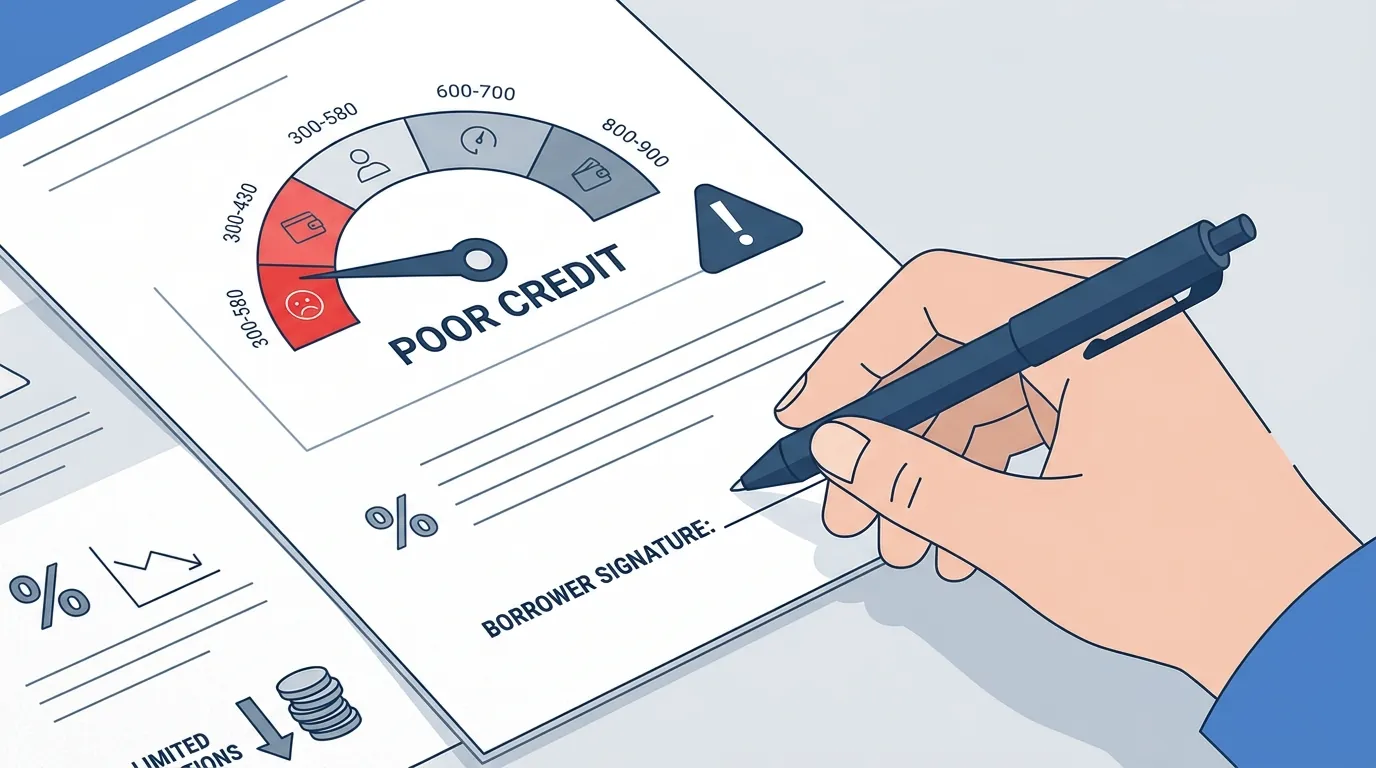
Some dealerships specialize in financing borrowers with limited or poor credit histories.
These businesses are sometimes described as buy-here-pay-here dealerships because the dealer provides financing directly rather than arranging a loan through a separate bank or finance company.
The CFPB notes that interest rates at these dealerships tend to be higher and recommends comparing the full cost with financing available from banks or credit unions.
For borrowers with weaker credit, this comparison is particularly important.
An approval can solve the immediate transportation problem, but the cost of financing may significantly affect the overall value of the purchase.
Check Whether the Contract Matches the Negotiated Deal
Before signing, review every figure in the final paperwork.
Check:
- Vehicle price
- Down payment
- Trade-in value
- Amount financed
- APR
- Finance charge
- Loan term
- Monthly payment
- Number of payments
- Total of payments
- Optional products
- Fees
- Prepayment provisions
The CFPB advises consumers to check the final documents carefully and make sure the terms match what was agreed upon.
Do not rely solely on verbal promises.
If a number or term is different from what you discussed, ask for a written explanation before signing.
Be Careful With Trade-Ins
If you are trading in another vehicle, determine its value and outstanding loan balance separately.
If you owe more than the vehicle is worth, you have negative equity.
For example:
Existing loan balance: $18,000
Trade-in value: $14,000
Negative equity: $4,000
If that $4,000 is rolled into the new auto loan, the new vehicle financing begins with additional debt.
The FTC warns that rolling negative equity into a new vehicle loan can increase the amount financed and the total cost of the new purchase.
Ask the dealer to show exactly how the existing loan is being handled.
Consider Insurance Before Finalizing the Purchase
Insurance costs can vary substantially between vehicles.
Before signing a financing agreement, obtain an insurance quote for the specific vehicle.
This is especially important when comparing vehicles with different values, safety features, repair costs, or theft risks.
A buyer who calculates affordability using only the loan payment can underestimate the actual monthly transportation expense.
The lender may also require specific insurance coverage while the vehicle is financed.
Confirm those requirements before finalizing the purchase.
Shop Within a Realistic Budget
A practical used-car budget should include both the purchase and ownership costs.
Start with monthly income and essential expenses.
Then consider:
- Housing
- Utilities
- Food
- Existing debt payments
- Insurance
- Transportation
- Savings
- Maintenance
- Emergency expenses
The CFPB recommends creating a monthly spending plan before shopping for an auto loan.
The goal is not simply to qualify for the largest loan a lender will approve.
It is to purchase a vehicle while maintaining enough cash flow for other financial obligations.
Questions to Ask Before Financing a Used Vehicle
Before signing a used-car financing agreement, ask:
What is the vehicle's complete out-the-door price?
Get the figure in writing before negotiating financing.
What is the APR?
Use it to compare the cost of borrowing across lenders.
How much will I pay in total?
Review the total of payments, not just the monthly installment.
How long is the loan?
A longer term can lower the monthly payment while increasing interest costs.
What fees are included?
Identify dealer, lender, documentation, and other charges.
Are optional products included?
Ask whether warranties, GAP, insurance, or other products have been added.
Has the vehicle been independently inspected?
If not, consider arranging an inspection before completing the purchase.
What does the Buyer's Guide say?
Determine whether the vehicle is sold with a warranty or "as is."
What happens to my trade-in loan?
Make sure any negative equity is clearly disclosed.
Final Considerations
Used-car financing requires two separate evaluations: whether the vehicle is worth purchasing and whether the financing makes sense.
Before committing to a pre-owned vehicle, review its history, condition, mileage, warranty status, and expected ownership costs. The FTC recommends obtaining a vehicle history report and independent inspection and reviewing the used-car Buyer's Guide before completing the transaction.
On the financing side, compare banks, credit unions, and dealer-arranged offers. Review APR, finance charges, amount financed, loan term, total payments, and optional products rather than relying on the monthly payment alone. The CFPB recommends obtaining financing offers before visiting the dealership when possible and comparing them with the dealer's proposal.
Long loan terms, negative equity, high APRs, and unnecessary add-ons can substantially increase the cost of a used vehicle.
The strongest protection is understanding the entire transaction before signing. A used car may have an attractive purchase price, but the final financial commitment depends on the vehicle, the loan, and all of the costs attached to both.
References
-
Federal Trade Commission — Buying a Used Car From a Dealer
-
Federal Trade Commission — Financing or Leasing a Car
-
Federal Trade Commission — Auto Trade-Ins and Negative Equity: When You Owe More Than Your Car Is Worth
-
Consumer Financial Protection Bureau — What Should I Know Before I Shop for a Car or Auto Loan?
-
Consumer Financial Protection Bureau — What Things Can I Negotiate When Shopping for a Car or Auto Loan?
-
Consumer Financial Protection Bureau — Am I Required to Get My Auto Loan Through a Dealership?
-
Consumer Financial Protection Bureau — What Is a Finance and Insurance (F&I) Department?
-
Consumer Financial Protection Bureau — What Should I Know Before I Finalize a Car or Auto Loan?
-
Consumer Financial Protection Bureau — Am I Required to Purchase an Extended Warranty, GAP Insurance, or Credit Insurance?
-
Consumer Financial Protection Bureau — What Are the Different Ways to Buy or Finance a Car or Vehicle?