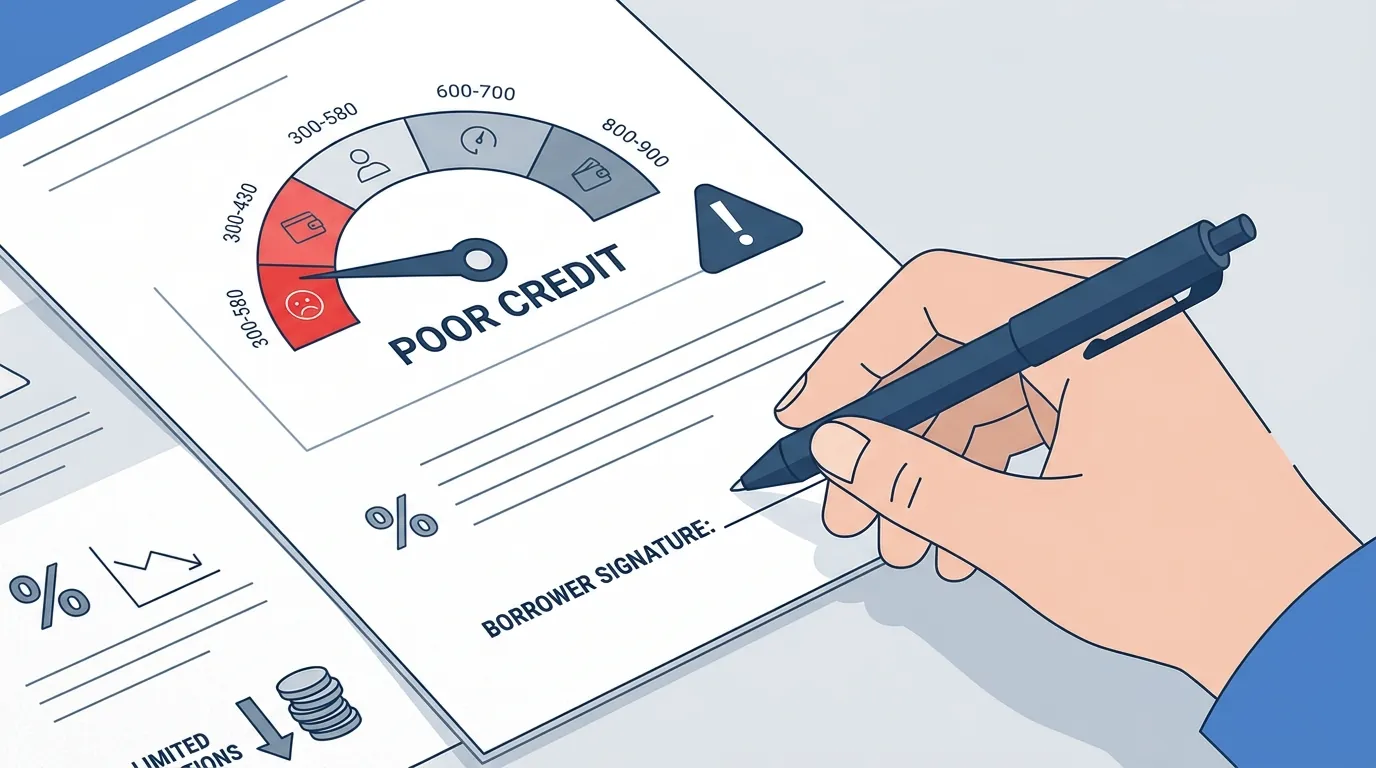
Buying a vehicle with a weaker credit profile can be more complicated than simply finding a car and applying for financing. Credit history, income, existing debt, down payment, loan amount, and the vehicle itself can all influence the terms a lender offers. A borrower with a lower credit score may still qualify for an auto loan, but the interest rate, required down payment, loan term, and total borrowing cost can differ substantially from offers available to borrowers with stronger credit.
Refinancing can provide another option for someone who already has an auto loan. If financial circumstances or credit history have improved, a new lender may offer different terms that reduce the interest rate or change the repayment schedule. However, refinancing is not automatically beneficial. A lower monthly payment can sometimes result from extending the loan rather than reducing the overall cost.
Understanding how bad-credit auto financing works and what to examine before refinancing can help borrowers evaluate the complete financial commitment.
How Credit Affects Auto Loan Terms
Credit scores are one of several factors auto lenders may consider when determining loan terms.
The CFPB says lenders generally look at credit scores and history, income, existing debts, loan amount, loan term, and down payment when determining an auto loan's interest rate and terms.
A lower credit score can make borrowing more expensive because lenders may view the application as carrying greater repayment risk.
Credit score is not the only consideration, however. Two borrowers with similar scores can receive different offers because their incomes, debt obligations, down payments, requested loan amounts, or vehicles differ.
The vehicle itself can also affect financing. Lenders may consider the loan-to-value ratio, which compares the amount borrowed with the vehicle's value. A high ratio can affect whether a lender approves the loan and the terms it offers.
Review Your Credit Before Shopping
Checking your credit before visiting a dealership can help you understand what lenders may see.
Review your credit reports for:
- Incorrect account balances
- Accounts that do not belong to you
- Incorrect late-payment information
- Duplicate accounts
- Outdated information
- Other inaccuracies
The CFPB recommends reviewing credit reports before shopping for an auto loan and disputing errors that could affect financing terms.
A credit report review can also help explain why an application may receive a higher rate than expected.
Consumers should remember that they do not have a single universal credit score. Different scoring models can produce different scores depending on the information used and the type of credit being evaluated.
Consider Preapproval Before Visiting a Dealer
One way to create a reference point is to seek financing from a bank, credit union, or other lender before shopping for the vehicle.
A preapproval can provide information about the approximate APR, loan amount, and repayment term for which you may qualify.
The FTC recommends shopping for financing before going to the dealership. With a preapproved offer, a buyer can compare the dealer's financing against an existing offer rather than negotiating the vehicle price and financing entirely at the dealership.
A preapproval is not necessarily the final financing agreement. Conditions can change once the lender evaluates the specific vehicle and final purchase details.
Still, having an outside financing offer can make comparisons easier.
Compare APR Rather Than Only the Interest Rate
The interest rate tells you the cost of borrowing the principal.
APR provides a broader measure because it incorporates the interest rate and certain additional fees associated with the loan.
The CFPB explains that APR is one of the key figures consumers can use to compare auto loans and that lenders generally must provide required APR disclosures before the borrower finalizes the loan.
This distinction is especially important for borrowers with weaker credit because a loan with a seemingly attractive rate can still carry additional costs.
When comparing offers, review:
- APR
- Interest rate
- Amount financed
- Loan term
- Monthly payment
- Finance charge
- Total amount paid
- Down payment
- Fees and add-ons
Looking at the complete financing package makes it easier to identify the actual cost.
A Larger Down Payment Can Change the Loan
A down payment reduces the amount that needs to be financed.
For example, if a vehicle costs $25,000 and a borrower makes a $5,000 down payment, the amount financed before taxes, fees, and other adjustments is lower than it would be with no down payment.
A larger down payment can also reduce the loan-to-value ratio, which can affect financing terms. The CFPB notes that increasing a down payment reduces the amount borrowed and can reduce the amount paid over the life of the loan.
However, borrowers should avoid draining emergency savings simply to increase a down payment.
The appropriate amount depends on the individual's overall financial situation.
Watch the Loan Term
A longer loan term can make the monthly payment appear more manageable.
But extending repayment can increase the total interest paid.
The FTC warns that longer auto loans can reduce monthly payments while making the overall financing more expensive. It also notes that vehicles can lose value quickly, creating a risk that a borrower owes more than the vehicle is worth.
This issue can become particularly important for borrowers with higher interest rates.
A long repayment period combined with a high APR can produce a substantial total finance charge.
When comparing offers, calculate the total amount paid over the entire loan rather than choosing based solely on the monthly payment.
Understand Dealership Financing
Dealership financing can be convenient because the dealer may submit an application to several lenders or finance companies.
However, consumers should not assume that the dealer's first offer represents the only available financing.
The FTC explains that dealership financing can include compensation for the dealer for arranging the financing, which can affect the rate offered to the consumer. It recommends comparing dealership financing with offers from banks, credit unions, and finance companies.
A borrower with poor credit may have fewer financing choices, making comparison even more important.
Ask for the financing terms in writing and review the final contract carefully before signing.
Co-Signers Can Affect Financing
A borrower with limited or poor credit history may be asked to provide a co-signer.
A co-signer becomes contractually responsible for the debt if the primary borrower cannot pay.
The CFPB notes that a co-signer with stronger credit may help an applicant obtain a lower interest rate because the lender can consider the co-signer's credit history and score.
But co-signing creates significant financial responsibility for the other person.
If payments are missed, the consequences can affect both the borrower and co-signer's credit. The co-signer may also be responsible for the debt under the contract.
Anyone considering this arrangement should understand the obligation before signing.
Be Careful With Dealer Add-Ons
Vehicle financing can include more than the vehicle's purchase price and interest.
Dealers may offer products such as:
- Extended service contracts
- GAP products
- Credit insurance
- Maintenance plans
- Theft protection
- Window etching
- Other aftermarket products
The FTC emphasizes that add-ons cost money and can be financed as part of the loan, meaning the borrower may also pay interest on those products.
Consumers should ask for the price of each add-on separately and determine whether it is actually needed.
A borrower with limited credit may already face a relatively expensive loan, so adding optional products can increase the total financing obligation further.
Negative Equity Can Complicate a Purchase
Negative equity occurs when a borrower owes more on an existing vehicle than that vehicle is worth.
For example, suppose a car is worth $15,000 but the borrower still owes $18,000. The $3,000 difference is negative equity.
When the borrower trades in the vehicle, the outstanding difference does not automatically disappear.
The FTC warns that dealers may effectively roll negative equity into the new vehicle financing, increasing the amount borrowed.
This can create a larger loan balance and cause the borrower to pay interest on debt associated with the previous vehicle.
Borrowers should therefore ask exactly how an existing loan will be handled before agreeing to a trade-in.
What Is Auto Loan Refinancing?
Auto refinancing means replacing an existing vehicle loan with a new loan.
The new lender typically pays off the existing loan, and the borrower makes payments under the new financing agreement.
The purpose can vary.
A borrower might refinance because:
- Credit has improved
- Income has increased
- Market rates have changed
- The original financing was expensive
- The borrower wants a different repayment term
- The current payment has become difficult to manage
The potential benefit is a change in the financing terms.
But refinancing should be evaluated using the entire new loan rather than the new monthly payment alone.
When Refinancing May Change the Cost
Suppose a borrower originally financed a vehicle at a relatively high APR because of a weak credit profile.
After making consistent payments and improving the credit profile, the borrower may qualify for a lower rate.
If the new loan has a lower APR and similar remaining term, refinancing could potentially reduce future interest costs.
However, refinancing later in the original loan does not necessarily produce large savings.
Some of the original interest has already been paid, and refinancing can restart the repayment schedule.
The borrower should compare the remaining balance and remaining interest under the existing loan with the total future payments under the proposed refinance.
Lower Payment Does Not Automatically Mean Savings
One of the most important refinancing considerations is the loan term.
Imagine a borrower has three years remaining on an auto loan. A refinance could reduce the monthly payment by extending the new loan over five years.
The payment is lower, but the borrower is making payments for two additional years.
Depending on the new rate and fees, total interest could increase rather than decrease.
The FTC warns consumers about refinancing offers that emphasize lower monthly payments without making the complete cost clear.
Before refinancing, compare:
Current remaining balance
Current APR
Remaining months
Current remaining payments
New APR
New loan term
New fees
New total repayment
That comparison gives a clearer picture of whether refinancing actually changes the economics of the loan.
Refinancing May Be Harder on Older Vehicles
The vehicle itself can influence refinancing eligibility.
As a car ages and depreciates, its value may decline while the remaining loan balance stays relatively high.
A lender evaluating a refinance may consider the vehicle's age, mileage, value, and loan-to-value ratio.
If the borrower owes substantially more than the vehicle is worth, refinancing may be more difficult or may come with less favorable terms.
The same issue can arise when negative equity has been rolled into the original loan.
Watch for Auto Refinancing Scams
Consumers should be especially cautious when looking for refinancing because financial difficulty can make promises of lower payments appealing.
The FTC warns about auto-refinancing scams in which companies demand an upfront fee and promise to reduce the borrower's monthly payment. Some scammers instruct consumers to stop paying their lender while supposedly negotiating a new arrangement.
The FTC advises consumers to be wary of companies that guarantee they can lower payments.
A legitimate refinancing transaction should involve a clearly identified lender, documented loan terms, and a clear explanation of who will receive the existing loan payoff.
Never assume that a company contacting you about refinancing is actually affiliated with your current lender.
Multiple Loan Inquiries and Rate Shopping
Shopping around can help borrowers compare financing offers, but credit inquiries should still be managed carefully.
The CFPB notes that multiple auto-loan inquiries made within a relatively short shopping period can generally be treated as a single inquiry for scoring purposes, with the relevant window varying by scoring model. Its current consumer guidance recommends keeping rate-shopping inquiries within roughly 14 to 45 days.
This makes it possible to compare multiple lenders without treating every inquiry as an entirely separate borrowing event.
Consumers should still confirm how a particular lender conducts its credit check before submitting an application.
What to Do Before Refinancing
Start by reviewing the existing auto loan.
Find:
- Current payoff amount
- Current APR
- Remaining term
- Remaining monthly payments
- Prepayment provisions
- Any fees associated with paying off the loan
Then review the vehicle itself.
Determine its approximate current value and compare that with the outstanding balance.
Finally, obtain refinancing offers and compare them with the existing loan.
A lower interest rate can be useful, but only if the complete refinancing structure reduces the cost or provides a payment that is genuinely more sustainable without creating an unnecessarily expensive longer-term obligation.
Questions to Ask a Refinancing Lender
Before accepting an offer, ask:
What is the APR?
Do not compare only the advertised interest rate.
What is the new loan term?
A longer term can reduce payments while increasing the repayment period.
What is the total amount I will repay?
Compare it with the remaining cost of the existing loan.
Are there application or origination fees?
Identify every upfront and financed charge.
Will the current lender charge a payoff fee?
Review the existing contract.
How will the vehicle's value affect the offer?
Ask whether age, mileage, or loan-to-value limits apply.
Is the refinancing fully approved?
Do not stop making existing payments simply because someone says an application is being processed.
A Practical Comparison
Consider a hypothetical borrower who has $18,000 remaining on an auto loan.
The existing loan has a relatively high APR and 36 months remaining. A refinancing lender offers a lower APR but extends repayment to 48 months.
The new monthly payment could be lower.
That does not automatically mean the refinance is cheaper.
The borrower should calculate the remaining payments under the existing loan and compare them with the total payments under the new agreement, including any refinancing fees.
If the borrower can afford the existing payment, a shorter remaining term may produce a lower total cost even if the monthly payment is higher.
If the existing payment is causing financial stress, the longer term may provide cash-flow relief, but the borrower should understand the additional cost before choosing it.
Final Considerations
Bad-credit auto financing can provide access to transportation when a borrower cannot qualify for conventional rates, but the cost of that access deserves careful attention.
Credit score and history, income, debt obligations, down payment, loan amount, vehicle value, and loan term can all influence the financing offered.
Before purchasing a vehicle, compare financing from banks, credit unions, and dealerships when possible. Review the APR, amount financed, term, fees, and total repayment rather than focusing only on the monthly payment.
Refinancing can potentially change an expensive auto loan, particularly if the borrower's credit profile or financial circumstances have improved. But extending the loan can increase the repayment period, and a lower monthly payment does not necessarily mean a lower total cost.
Borrowers should also be cautious about negative equity, unnecessary add-ons, co-signer obligations, and refinancing companies that demand upfront fees or promise guaranteed payment reductions.
The central question is not simply whether a lender will approve the application. It is whether the complete financing arrangement fits the borrower's budget and makes sense over the remaining life of the vehicle loan.
References
- Consumer Financial Protection Bureau — How Does a Lender Decide What Interest Rate to Offer Me on an Auto Loan? Consumer Financial Protection Bureau
- Consumer Financial Protection Bureau — What Should I Know Before I Shop for a Car or Auto Loan? Consumer Financial Protection Bureau
- Consumer Financial Protection Bureau — What Is a Loan-to-Value Ratio in an Auto Loan? Consumer Financial Protection Bureau
- Consumer Financial Protection Bureau — What Is the Difference Between a Loan Interest Rate and the APR? Consumer Financial Protection Bureau
- Federal Trade Commission — Financing or Leasing a Car Federal Trade Commission
- Federal Trade Commission — Auto Trade-Ins and Negative Equity: When You Owe More Than Your Car Is Worth Federal Trade Commission
- Federal Trade Commission — Auto Loan Refinancing Scams Federal Trade Commission