Personal loans can provide a fixed amount of financing for debt consolidation, home improvements, major purchases, unexpected expenses, or other qualifying needs. But two loans with the same borrowing amount can have very different costs depending on the interest rate, APR, repayment period, fees, and other contractual terms.
A personal loan is generally a closed-end installment loan: the borrower receives a specified amount and repays it through scheduled installments over a defined period. Lenders may consider credit history, income, existing debts, loan amount, repayment term, and other factors when determining the terms offered.
Comparing personal loans therefore requires more than looking at the advertised monthly payment. The objective is to understand how much money will be received, how much will be repaid, how long repayment will take, and what conditions apply along the way.
Start With the Amount You Actually Need
Before comparing lenders, determine the amount required for the expense.
Borrowing more than necessary can increase interest costs and the required monthly payment. On the other hand, borrowing too little can leave a borrower needing additional financing later.
Suppose a borrower needs $15,000 for a home repair. If a lender approves $25,000, that does not mean the borrower should automatically take the larger amount.
The comparison should begin with:
- Amount needed
- Amount offered
- Minimum and maximum loan amounts
- Expected fees
- Net amount deposited
- Intended repayment period
This becomes particularly important when a lender charges an origination fee that is deducted from the proceeds.
For example, a $20,000 loan with a 5% origination fee could result in $19,000 being delivered to the borrower before other applicable charges.
The loan balance, however, may still be based on the full amount financed.
Interest Rate vs. APR
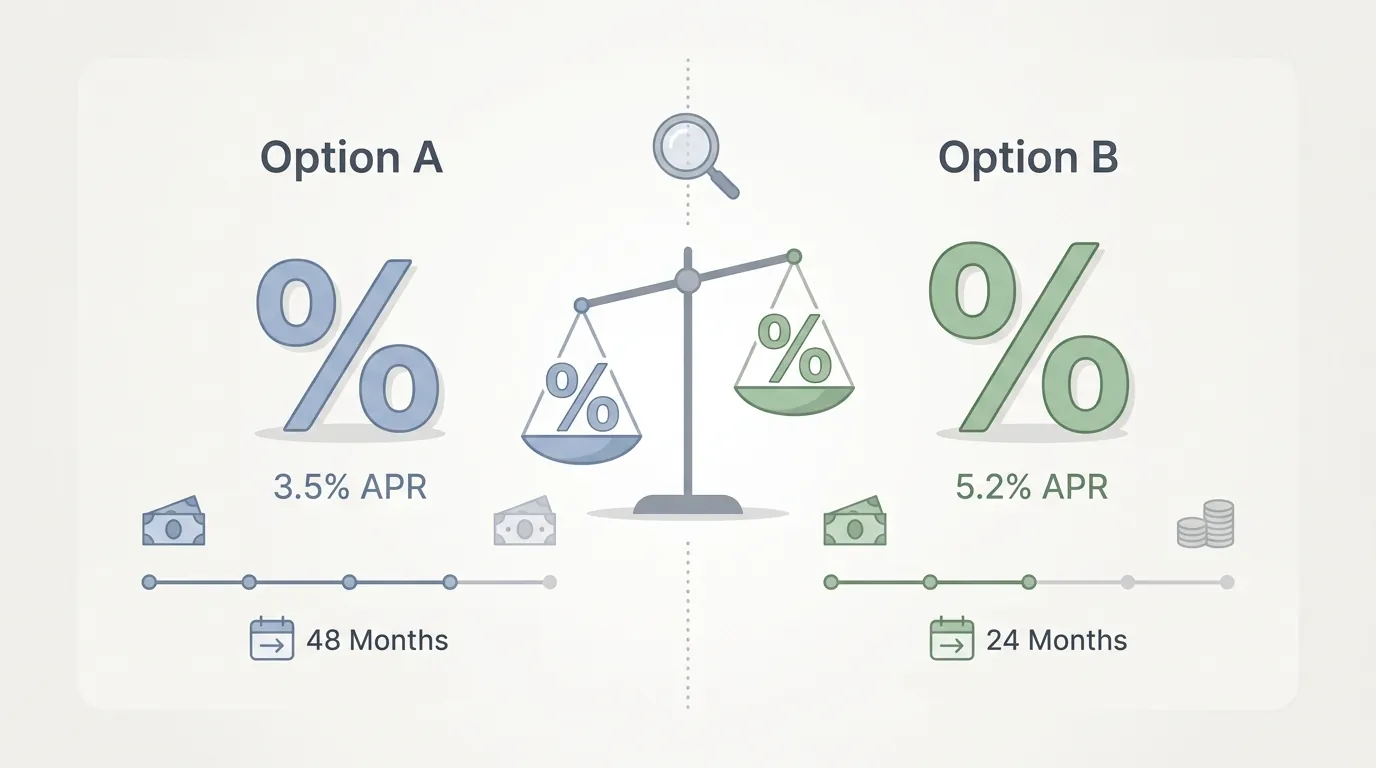
One of the most important distinctions when comparing personal loans is the difference between the interest rate and the annual percentage rate (APR).
The interest rate represents the cost of borrowing the principal.
APR is a broader measure that incorporates the interest rate and certain additional charges associated with the loan. The CFPB describes APR as a way to compare the cost of borrowing while taking applicable fees into account.
For example:
Loan A
- Interest rate: 10%
- Origination fee: 0%
Loan B
- Interest rate: 9%
- Origination fee: 5%
Loan B has the lower stated interest rate, but the origination fee changes the economics of the transaction.
That does not automatically make either loan cheaper. The repayment term and other costs also matter.
For this reason, borrowers should compare APR to APR when the loans are structured comparably rather than comparing one lender's interest rate with another lender's APR.
Why Loan Fees Matter
Personal installment loans can include several types of fees.
The CFPB identifies potential charges such as:
- Origination fees
- Documentation fees
- Late fees
- Returned-payment fees
- Optional credit insurance
- Other lender-specific charges
Not every lender charges every fee.
When reviewing an offer, determine whether fees are:
Deducted from the loan proceeds: The borrower receives less cash than the stated loan amount.
Added to the balance: The borrower finances the fee and may pay interest on it.
Paid separately: The borrower must provide the money independently of the loan proceeds.
The loan agreement should specify how each charge is handled.
Compare Repayment Terms
The loan term determines how long the borrower has to repay the debt.
Common personal-loan terms can range from several months to several years, depending on the lender and product.
A shorter term generally produces a higher required monthly payment but can reduce the amount of interest paid over the life of the loan.
A longer term generally reduces the monthly payment but gives interest more time to accumulate.
Consider a hypothetical $20,000 fixed-rate loan:
| Term | Monthly Payment | Repayment Period | General Effect |
|---|---|---|---|
| 3 years | Higher | Shorter | Less time for interest to accrue |
| 5 years | Moderate | Medium | Balance between payment and duration |
| 7 years | Lower | Longer | More time for interest to accrue |
The exact payments depend on the interest rate.
The important point is that monthly affordability and total borrowing cost are separate measurements.
Don't Compare Loans by Monthly Payment Alone
A low monthly payment can make a loan appear inexpensive even when the borrower will pay substantially more interest over time.
The CFPB similarly warns consumers comparing loans to consider the APR, interest rate, loan length, and total amount financed rather than focusing exclusively on the monthly payment.
For example:
Loan A
- $20,000 borrowed
- 9% APR
- 3-year term
- Higher monthly payment
Loan B
- $20,000 borrowed
- 9% APR
- 7-year term
- Lower monthly payment
Loan B may be easier to fit into a monthly budget, but interest accrues over a much longer period.
A borrower should therefore calculate both:
Monthly payment
and
Total amount repaid
before choosing a term.
Fixed vs. Variable Personal Loan Rates
Some personal loans have fixed interest rates, while others can have adjustable or variable rates.
With a fixed-rate loan, the interest rate remains unchanged under the loan agreement.
With a variable-rate loan, the rate can change according to the applicable index, margin, adjustment schedule, and contractual limits.
A variable-rate loan may initially offer a lower rate, but the borrower assumes additional uncertainty because future payments or interest costs can change.
When evaluating a variable-rate offer, ask:
- What index determines the rate?
- What margin is added?
- How often can the rate change?
- Is there a maximum rate?
- Is there a minimum rate?
- Can the monthly payment change?
- What happens if rates rise substantially?
For borrowers who prioritize predictable monthly payments, the difference between fixed and variable financing can be significant.
Credit Score and Loan Pricing
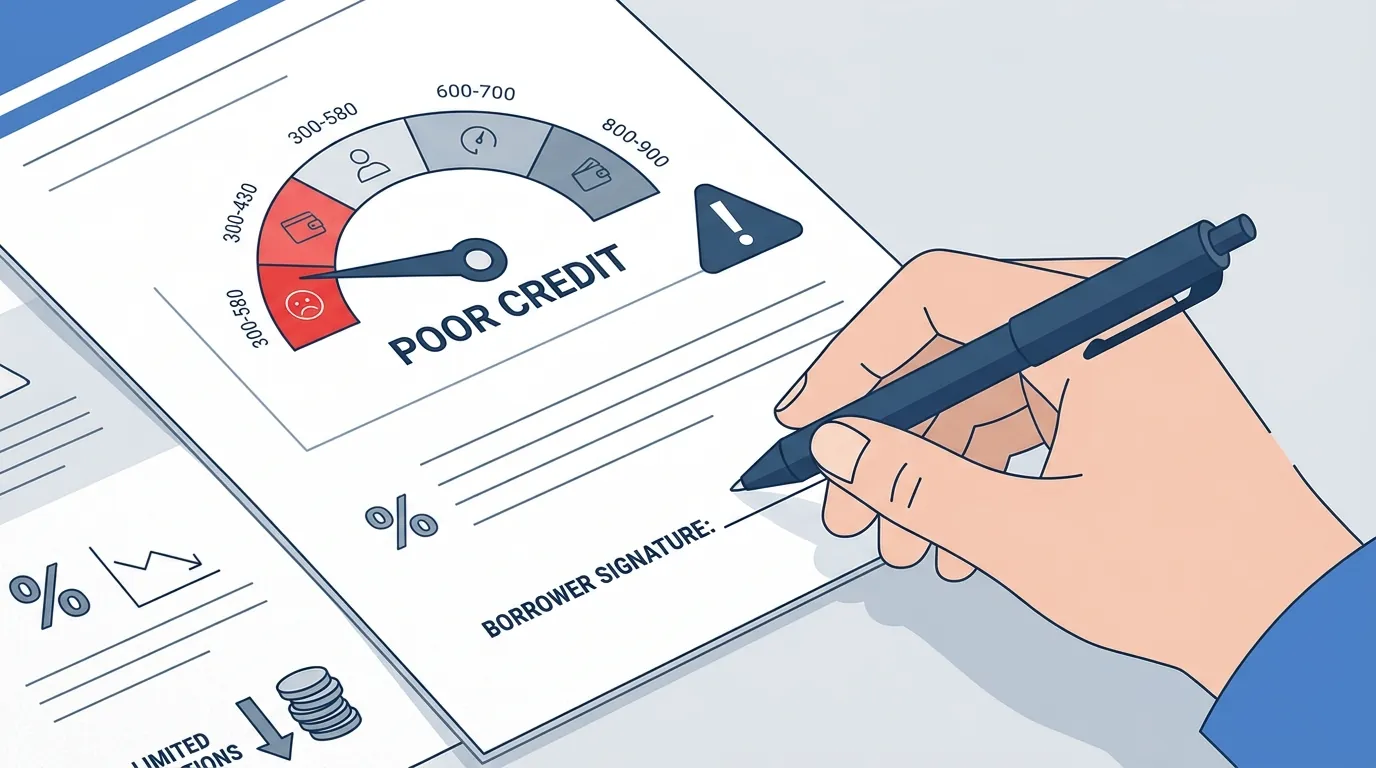
Credit history can influence both approval and the terms offered.
The CFPB states that lenders commonly consider factors such as credit score and reports, income, debts, loan amount, loan term, and applicable state-law limits when determining personal-loan terms.
A borrower with stronger credit may receive a different interest rate from someone with a limited or damaged credit history.
Other factors can matter as well.
For example, two borrowers with similar credit scores could receive different offers if their incomes, existing debts, requested loan amounts, or repayment periods differ.
This is why advertised rate ranges should not be treated as a guaranteed offer.
Prequalification and Credit Inquiries
Some lenders allow borrowers to check potential loan terms before submitting a full application.
Depending on the lender, an initial rate check may use a soft credit inquiry, while proceeding with a formal application may result in a hard inquiry.
Borrowers should confirm which type of credit inquiry will occur at each stage.
If several lenders offer prequalification without a hard inquiry, comparing preliminary offers can provide useful information before deciding where to submit a full application.
However, the prequalified rate is not necessarily the final rate.
Final pricing may depend on verification of income, credit history, debt obligations, loan amount, and other underwriting information.
Compare Net Proceeds, Not Just the Loan Amount
Origination fees can make the amount borrowed different from the amount actually received.
Imagine two hypothetical offers for a borrower who needs $25,000.
Offer A
- Loan amount: $25,000
- Origination fee: 0%
- Net proceeds: $25,000
Offer B
- Loan amount: $25,000
- Origination fee: 4%
- Net proceeds: $24,000
If the borrower needs $25,000 in usable funds, Offer B may require a larger loan amount or another source of cash.
The CFPB recommends reviewing lender disclosures and loan documents for fees and comparing multiple offers before agreeing to a personal installment loan.
This is especially relevant when the loan is being used for a specific purchase or debt-consolidation amount.
Consider the Total Interest
The total interest paid over the life of a loan can differ substantially based on the rate and term.
For an amortizing fixed-rate loan, each scheduled payment generally contains both interest and principal. Early in the repayment period, a larger portion of the payment can go toward interest. As the balance declines, the interest component generally falls.
This means that making additional principal payments can potentially reduce future interest, assuming the loan permits early repayment without a relevant penalty.
Borrowers should ask how additional payments are applied and whether the lender charges a prepayment penalty.
Check for Prepayment Penalties
Some borrowers want the flexibility to repay a loan ahead of schedule.
Before signing, check whether the contract includes a prepayment penalty or other restrictions on early payoff.
A borrower who expects to receive a bonus, sell an asset, or otherwise make large additional payments may place a higher value on a loan that permits early repayment without an additional charge.
The existence and treatment of prepayment penalties depend on the loan agreement and applicable law.
The CFPB recommends reviewing the loan contract for these provisions rather than assuming that early repayment is always cost-free.
Compare the Full Loan Structure
A useful personal-loan comparison can look like this:
| Factor | Offer A | Offer B | Offer C |
|---|---|---|---|
| Loan amount | $20,000 | $20,000 | $20,000 |
| Interest rate | 10.0% | 9.5% | 11.0% |
| APR | 10.0% | 11.2% | 11.0% |
| Origination fee | $0 | $340 | $0 |
| Term | 36 months | 48 months | 36 months |
| Monthly payment | — | — | — |
| Total repayment | — | — | — |
| Prepayment penalty | None | Review | None |
The table illustrates why a lower interest rate does not necessarily mean a lower overall cost.
The borrower needs to fill in the actual payment and total repayment figures from each lender's offer.
Secured vs. Unsecured Personal Loans
Most personal loans are unsecured, meaning the borrower does not pledge a specific asset as collateral.
Some lenders may offer secured personal-loan products, however.
A secured loan can potentially have different pricing because the lender has collateral supporting the debt.
An unsecured loan places greater emphasis on the borrower's creditworthiness and repayment capacity.
If comparing secured and unsecured offers, include the collateral risk in the analysis.
A lower interest rate may come with the consequence that a vehicle, savings account, or other asset is pledged against the debt.
Debt Consolidation Requires an Extra Calculation
Personal loans are frequently used to consolidate credit-card or other high-interest debt.
In that situation, borrowers should compare the new loan's total cost with the actual cost of the debts being replaced.
For example:
Existing debt
- $15,000 balance
- 24% credit-card APR
Potential consolidation loan
- $15,000 balance
- 12% APR
- 5% origination fee
- Five-year term
The lower rate could reduce the cost of interest, but the longer repayment period and origination fee must also be considered.
There is another behavioral issue: if the original credit-card accounts remain available and balances accumulate again, the borrower can end up with both the new personal loan and new revolving debt.
Consolidation changes the structure of debt; it does not eliminate the need for sustainable cash flow.
Watch for Unusual Upfront Fees
Borrowers should also distinguish legitimate loan fees from potential scams.
The Federal Trade Commission warns that legitimate lenders do not guarantee approval in exchange for an upfront payment. A demand for money before providing a promised loan, particularly when presented as a condition for guaranteed approval, can be a warning sign of an advance-fee loan scam.
Consumers should verify the lender's identity, licensing or registration where applicable, and written loan terms before sending money or personal information.
A legitimate loan comparison should provide clear information about the amount borrowed, APR, fees, repayment schedule, and applicable conditions.
Questions to Ask Before Accepting a Personal Loan
Before signing a loan agreement, borrowers can ask:
- What is the exact interest rate?
- What is the APR?
- Is the rate fixed or variable?
- What is the loan term?
- What will the monthly payment be?
- How much will I repay in total?
- Is there an origination fee?
- How much money will I actually receive?
- Are there late-payment or returned-payment fees?
- Is there a prepayment penalty?
- How are extra payments applied?
- Is collateral required?
- Will the application involve a hard credit inquiry?
- Can the loan be refinanced later?
- What happens if I miss a payment?
- Are there restrictions on how I use the loan?
Having these answers before accepting an offer can make lender comparisons much more meaningful.
A Practical Way to Compare Personal Loan Offers
A borrower can use a five-step process:
1. Determine the required loan amount. Avoid borrowing more than necessary.
2. Gather multiple offers. Compare several lenders rather than relying on one advertised rate.
3. Compare APR and fees. Look beyond the nominal interest rate.
4. Calculate monthly payment and total repayment. Make sure the payment fits the budget without overlooking the lifetime cost.
5. Review contractual terms. Check prepayment provisions, late fees, rate changes, collateral requirements, and other conditions.
The CFPB recommends shopping among multiple lenders when evaluating personal installment loans because different lenders can offer different terms.
The Role of the Loan Term in the Final Decision
The loan term deserves particular attention because it affects both immediate cash flow and long-term cost.
A shorter term can accelerate principal repayment and reduce the period during which interest accrues, but the required monthly payment may be substantially higher.
A longer term can make the payment easier to manage while increasing the time the borrower remains in debt.
Neither structure is automatically appropriate for every borrower.
The relevant question is whether the payment is sustainable without creating new financial stress, while the total borrowing cost remains reasonable for the purpose of the loan.
Comparing Loans Beyond the Headline Rate
Personal-loan advertisements often emphasize an attractive starting rate or low monthly payment. Those figures can be useful starting points, but they do not describe the entire financing arrangement.
A complete comparison should include:
- Loan amount
- Net proceeds
- Interest rate
- APR
- Origination fees
- Other charges
- Monthly payment
- Repayment term
- Total repayment
- Fixed or variable rate
- Prepayment provisions
- Late-payment costs
- Collateral requirements
- Credit requirements
The CFPB specifically identifies APR, fees, loan amount, repayment term, and other contractual features as important considerations when evaluating borrowing costs.
Ultimately, the most useful loan comparison is not the one with the most attractive headline number. It is the one that gives the borrower a clear understanding of what the financing will cost, how long repayment will take, how much cash will actually be received, and what obligations apply if circumstances change.
References
- Consumer Financial Protection Bureau — Personal Installment Loans CFPB: What Is a Personal Installment Loan?
- Consumer Financial Protection Bureau — Interest Rate vs. APR CFPB: Interest Rate vs. APR
- Consumer Financial Protection Bureau — Personal Loan Fees CFPB: Personal Installment Loan Fees
- Consumer Financial Protection Bureau — Comparing Loan Costs CFPB Consumer Borrowing Guidance
- Federal Trade Commission — Advance-Fee Loan Scams FTC: What To Know About Advance-Fee Loans