
Paying for college, graduate school, or professional education can require more funding than scholarships, grants, savings, and federal student aid provide. When those resources do not cover the remaining cost, a private student loan can fill part of the gap.
Private student loans are offered by banks, credit unions, state agencies, schools, and other private lenders rather than through the federal student loan system. Unlike federal loans, their rates, fees, eligibility requirements, repayment options, and borrower protections are established by the individual lender.
That flexibility can create more borrowing choices, but it also makes comparing loan terms particularly important. A private student loan should be evaluated based on its interest rate, APR, fees, repayment period, cosigner requirements, payment options, and protections if financial circumstances change.
How Private Student Loans Work
A private student loan generally provides funds to help cover eligible education expenses. Depending on the lender and school, the loan proceeds may be sent directly to the educational institution, which then applies the funds to the student's account and may disburse any remaining eligible amount.
Eligible expenses can include costs such as:
- Tuition
- Required fees
- Books and supplies
- Room and board
- Certain transportation expenses
- Other qualified education-related costs
The exact eligible expenses and annual borrowing limits depend on the lender and the school's certified cost of attendance.
Unlike federal student loans, private loans are not governed by one standardized federal loan structure. One lender may offer several repayment choices while another may have fewer options.
That makes the loan agreement particularly important.
Private vs. Federal Student Loans
Before borrowing privately, students should determine how much federal aid they are eligible to receive.
Federal Student Aid and the CFPB both recommend exploring federal student aid before taking out private education financing because federal loans generally provide more standardized borrower protections and repayment options.
| Feature | Federal Student Loans | Private Student Loans |
|---|---|---|
| Lender | Federal government | Bank, credit union, state agency, or private lender |
| Credit requirement | Generally no credit check for Direct Loans | Credit review commonly required |
| Cosigner | Generally not required for Direct Loans | May be required |
| Interest rate | Federal rates are generally fixed | Fixed or variable |
| Rate determination | Set under federal program rules | Primarily based on borrower credit and lender underwriting |
| Income-based repayment | Available for eligible federal loans/programs | Depends on lender |
| Deferment/forbearance | Federal programs provide defined options | Varies by lender |
| Loan forgiveness | Certain federal programs may provide it | Generally limited and lender-specific |
| Borrowing limits | Program-specific | Lender and school eligibility rules apply |
Federal student loans also have protections that are not automatically available with private loans, including certain repayment, deferment, forbearance, and forgiveness programs.
For that reason, private financing is generally considered a supplemental source when other education funding does not cover the required amount.
How Private Student Loan Interest Rates Work
Interest rates are one of the largest determinants of a student loan's long-term cost.
Private student loans may have either fixed or variable interest rates.
Fixed-rate student loans
A fixed interest rate remains unchanged during the loan term.
This makes monthly payments easier to forecast because the interest rate itself does not change.
The tradeoff is that a fixed-rate loan may initially carry a higher rate than a variable-rate option.
Variable-rate student loans
A variable rate can change over time according to the loan's terms.
If the underlying index changes, the interest rate and potentially the monthly payment can change as well. The CFPB notes that private student loans may have variable rates, while federal student loans generally have fixed rates.
A variable-rate loan can therefore create more uncertainty over a repayment period that may last several years.
Borrowers should ask the lender:
- What index determines the rate?
- What margin is added?
- How frequently can the rate change?
- Is there a maximum rate?
- Is there a minimum rate?
- How will a rate change affect the monthly payment?
Credit Scores and Private Student Loans
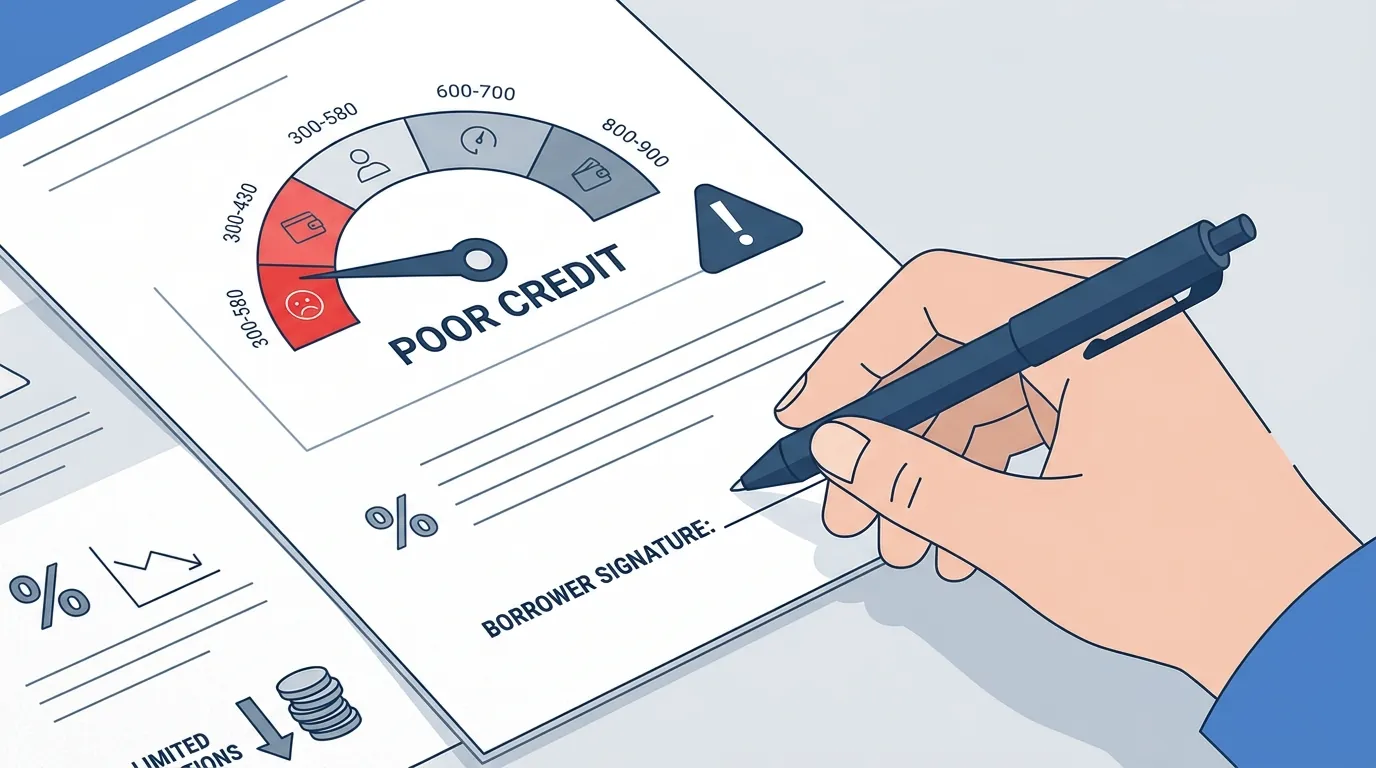
Credit history can have a major effect on private student loan pricing.
Lenders may evaluate:
- Credit score
- Payment history
- Existing debt
- Income
- Employment
- Credit history length
- Other financial obligations
The CFPB states that private student loan rates and fees are based primarily on credit history or credit score, among other factors.
Students who have limited credit histories may therefore have difficulty qualifying independently or may receive less favorable terms.
This is one reason private student loans frequently involve a cosigner.
Using a Cosigner
A cosigner is someone who agrees to repay the loan if the primary borrower does not meet the repayment obligation.
Parents, relatives, or other financially established individuals may sometimes cosign for a student.
A cosigner with stronger credit can potentially help the borrower qualify or receive a lower interest rate. However, the cosigner assumes a legally binding obligation.
The CFPB states that cosigners are equally responsible for repayment and that missed payments can affect both the student's and cosigner's credit histories.
Before using a cosigner, both parties should understand:
- The total loan amount
- Interest rate
- Monthly payment
- Repayment period
- Late-payment consequences
- Release requirements
- Default provisions
- Credit-reporting implications
Some private lenders offer cosigner release after the borrower meets specific requirements, such as making a required number of on-time payments and demonstrating sufficient creditworthiness. However, release is not automatic and varies by lender.
In-School Payments vs. Deferred Payments
One important difference between private student loans is when repayment begins.
Some private loans require students to make payments while they remain enrolled. Others allow borrowers to defer payments until after graduation or another qualifying event.
Federal Student Aid notes that many private student loans require payments while the student is still in school, although some lenders offer in-school deferment.
Even when payments are deferred, interest may continue accumulating.
For example, if a $20,000 loan accrues interest while the student is in school, the balance can increase before regular principal-and-interest payments begin.
Borrowers should therefore ask whether they can make:
- Full monthly payments
- Interest-only payments
- Fixed in-school payments
- No payments until graduation
Making interest payments while enrolled can reduce the amount of interest that eventually gets added to the outstanding balance, depending on the loan's terms.
Loan Fees and APR
Interest is not necessarily the only cost of private education financing.
A lender may charge fees such as:
- Origination fees
- Late-payment fees
- Returned-payment fees
- Application-related charges
- Other administrative fees
The annual percentage rate (APR) can help borrowers compare the overall cost of loans, although they should still review the complete fee schedule and loan agreement.
A loan with a lower advertised interest rate can have a different total cost if fees, discounts, or other terms differ.
Borrowers should calculate the amount they will actually receive and the amount they are expected to repay.
How Much Should You Borrow?
One of the most important decisions is determining the amount of private financing actually required.
A student's funding gap might look like this:
Cost of attendance: $35,000 Scholarships and grants: −$8,000 Savings and other resources: −$7,000 Federal student loans: −$15,000 Remaining gap: $5,000
In this example, borrowing $5,000 rather than taking the maximum private loan offered would limit the amount of additional debt.
Students should also consider whether expenses can be reduced before increasing borrowing.
Possible areas to review include:
- Housing
- Meal plans
- Transportation
- Course load
- Textbook expenses
- Campus fees
- School selection
- Available scholarships
Federal Student Aid specifically recommends exploring remaining financial-aid options and discussing the funding gap with the school's financial aid office before taking on additional private debt.
Comparing Private Student Loan Offers
Private student loan offers can look similar while producing different long-term costs.
A useful comparison should include:
| Factor | What to Check |
|---|---|
| Loan amount | Minimum and maximum available |
| Interest rate | Fixed or variable |
| APR | Overall annualized borrowing cost |
| Repayment term | Number of years |
| In-school payment | Required or optional |
| Grace period | Length and conditions |
| Origination fee | Amount or percentage |
| Cosigner | Required or optional |
| Cosigner release | Eligibility and timing |
| Late fees | Amount and conditions |
| Deferment | Availability during school or hardship |
| Forbearance | Whether temporary payment relief exists |
| Prepayment | Whether early payoff is permitted without a fee |
The CFPB recommends shopping among different private lenders rather than accepting the first offer.
Understanding the Total Cost
Monthly payment is only one part of the calculation.
Consider two hypothetical loans of $30,000:
Loan A
- 7% fixed interest
- 10-year repayment
- No origination fee
Loan B
- 6% variable starting rate
- 10-year repayment
- 2% origination fee
Loan B begins with a lower interest rate, but the borrower has additional upfront costs and the possibility that the variable rate could increase.
If the variable rate rises substantially, the payment and total interest cost could change.
This is why borrowers should examine both the initial payment and the potential cost over the entire repayment period.
What Happens If the Borrower Has Trouble Paying?
Financial hardship can be particularly important with private student debt because protections vary by lender.
Some private lenders may offer temporary payment relief, modified repayment arrangements, or other hardship programs. Others may provide fewer options.
Federal student loans have defined federal programs for certain forms of deferment, forbearance, and income-based repayment. Private student loans do not automatically provide equivalent protections.
Borrowers should review the hardship provisions before signing the loan agreement rather than waiting until a payment problem occurs.
Questions to ask include:
- Can payments be temporarily suspended?
- Does interest continue accumulating?
- How long can hardship relief last?
- Are eligibility requirements strict?
- Can the loan be modified?
- What happens after the relief period ends?
Refinancing Private Student Loans
After graduation, a borrower's financial profile may improve.
A student who initially needed a cosigner may eventually have stronger credit, stable income, and a longer credit history.
That can create an opportunity to refinance a private student loan through another private lender.
Refinancing can potentially:
- Reduce the interest rate
- Change the repayment term
- Lower the monthly payment
- Remove a cosigner under qualifying circumstances
- Combine multiple private loans
However, extending the repayment period can increase total interest even when the monthly payment falls.
Borrowers should also be careful when refinancing federal student loans into private loans. Doing so removes the loans from the federal student loan system and can result in losing federal benefits and protections.
Questions to Ask a Private Student Loan Lender
Before signing a loan agreement, borrowers can ask:
- What interest rate am I being offered?
- Is the rate fixed or variable?
- If variable, what index determines the rate?
- How frequently can the rate change?
- Is there a rate cap?
- What is the APR?
- Are there origination or other fees?
- When does repayment begin?
- Is interest charged while I am in school?
- Is there a grace period after leaving school?
- Do I need a cosigner?
- Can the cosigner eventually be released?
- What are the requirements for cosigner release?
- Are deferment or forbearance options available?
- Are there penalties for late payments?
- Can I make extra payments without a fee?
- How much will I repay over the entire loan term?
- What happens if I leave school before graduating?
Getting these answers in writing makes it easier to compare multiple offers.
Building an Education Financing Strategy
Private student loans can provide useful financing when scholarships, grants, savings, and federal aid do not fully cover educational costs. But they create a long-term repayment obligation, and their terms can vary significantly between lenders.
The most important distinction is that private student loans are not interchangeable with federal student loans. Private lenders can set their own underwriting standards, rates, fees, and repayment policies, while federal programs provide standardized protections that private loans generally do not replicate.
Students can begin by calculating the actual funding gap, reviewing their federal aid options, and discussing alternatives with the school's financial aid office. If private borrowing remains necessary, comparing multiple lenders can reveal differences in APR, fixed versus variable rates, cosigner requirements, repayment options, and total borrowing costs.
The goal is not simply to obtain enough money for the next semester. It is to understand how today's education financing decision affects monthly cash flow and total debt after graduation.
References
- Consumer Financial Protection Bureau — What Are Private Student Loans? CFPB: What Are Private Student Loans?
- Consumer Financial Protection Bureau — Choosing a Student Loan CFPB: Choosing a Student Loan
- Consumer Financial Protection Bureau — Private Student Loan Cosigners CFPB: Cosigners and Student Loans
- Federal Student Aid — Evaluating Financial Aid Offers Federal Student Aid: Evaluating Financial Aid Offers
- Federal Student Aid — Options When Financial Aid Is Not Enough Federal Student Aid: Additional Ways to Pay for College
- Consumer Financial Protection Bureau — Student Loan Consolidation and Refinancing CFPB: Consolidating or Refinancing Student Loans